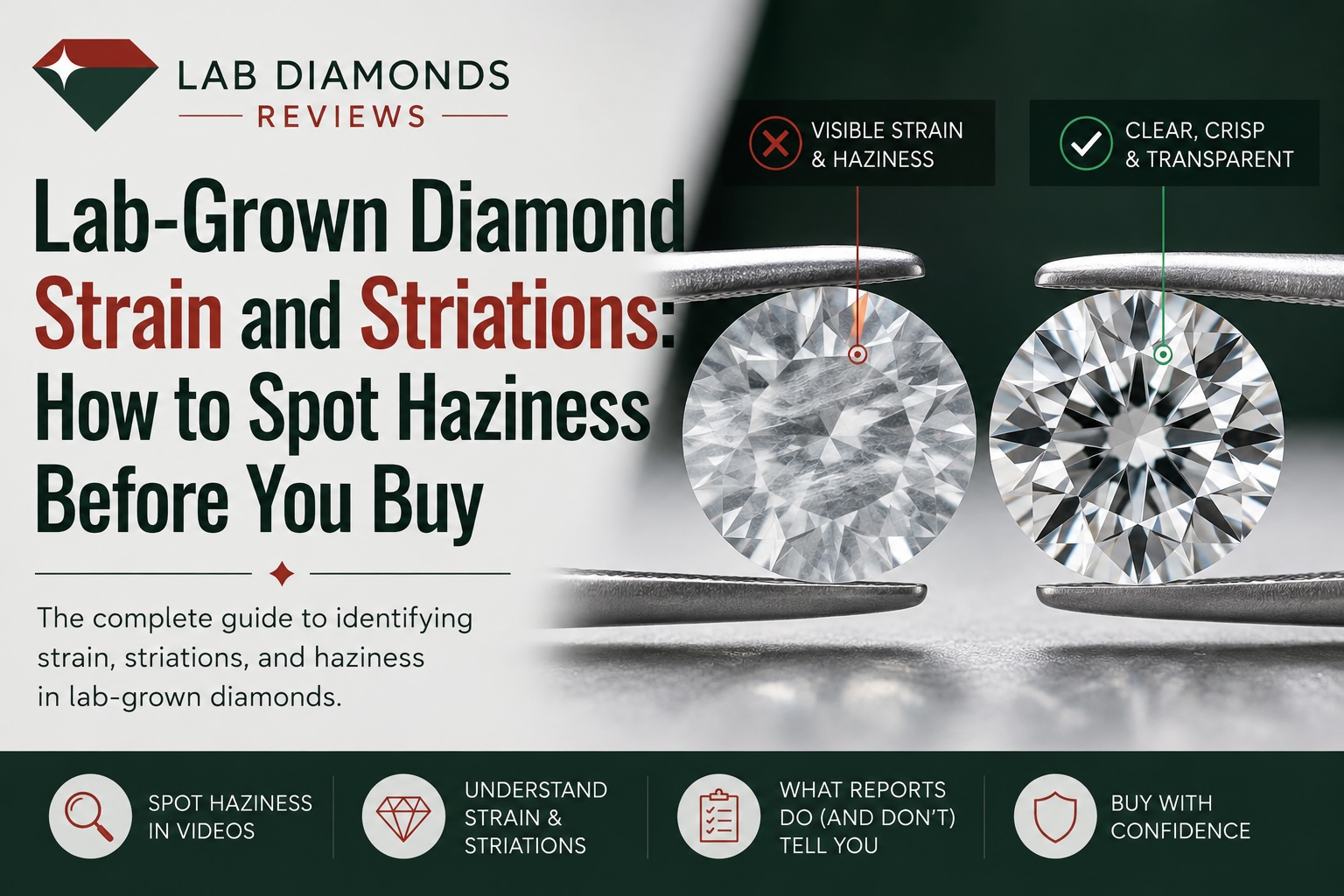
A lab-grown diamond can look excellent on its grading report and still appear slightly cloudy, sleepy, or hazy in person.
One possible reason is strain and growth-related graining within the diamond crystal.
This issue is particularly associated with some CVD lab-grown diamonds. During Chemical Vapor Deposition growth, carbon is deposited onto a diamond seed layer by layer. Irregularities in that growth can create internal stress, growth boundaries, graining, and striated patterns within the crystal. GIA research has documented strong birefringence, internal graining, and growth-related features in CVD-grown diamonds, although modern CVD material varies enormously in quality.
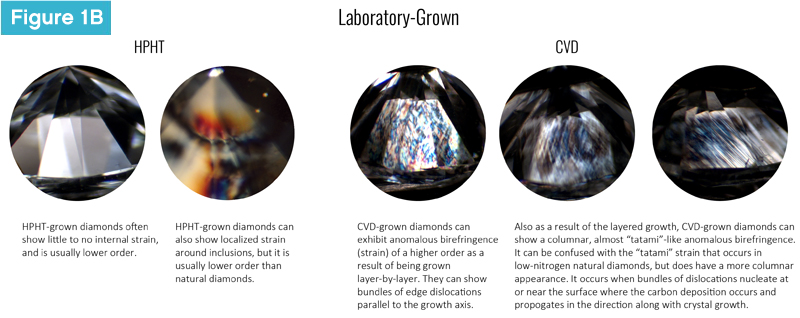
The important point for buyers is that not every CVD diamond has a visible transparency problem, and not every diamond showing internal strain will look hazy without specialist equipment.
But some do.
When those issues are severe enough to interfere with transparency, a diamond can lose the crisp, bright appearance you expect even if the certificate shows high color and clarity grades.
That is why I recommend assessing transparency and actual appearance separately from the 4Cs when buying a lab-grown diamond online.
If you are new to lab diamonds, start with my guide to the 4Cs of lab-grown diamonds before continuing.
Quick Answer: How Do You Avoid a Hazy Lab-Grown Diamond?
The safest approach is not to try to diagnose crystal strain from a grading report.
Instead:
- View high-resolution images of the actual diamond
- Use 360-degree video rather than stock photography
- Look through the table for crisp, well-defined facets
- Watch for a persistent milky, oily, or slightly blurred appearance
- Compare similar diamonds under the same lighting
- Ask the retailer specifically whether the diamond has transparency, strain, or graining issues
- Evaluate cut quality separately from crystal transparency
- Favor retailers that physically inspect or carefully vet the diamonds they sell
Most importantly, remember that clarity grade and transparency are not the same thing.
A diamond can receive an impressive clarity grade while still containing growth features that affect how crisp it looks.
GIA examined a 3.14 carat F-color, VVS2 CVD-grown oval diamond containing a dark brown growth band. Despite its VVS2 clarity grade, GIA reported that the band affected transparency in that area.
That is a useful real-world reminder that the grading report is only part of the buying process.
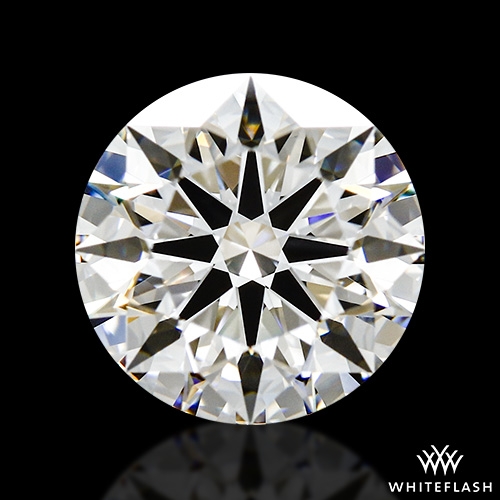
AN HPHT 1.01 ct D VVS1 Round Cut Precision Lab Grown Diamond from Whiteflash
What Is Strain in a Lab-Grown Diamond?
Diamond strain is internal stress within the crystal lattice.
In gemological testing, strain can be revealed as anomalous birefringence when a diamond is viewed between crossed polarizing filters. GIA describes these birefringence patterns as being attributable to strain within the diamond lattice.
This does not mean you will see colorful strain patterns when looking at your engagement ring.
Crossed-polarizer examination is a specialist gemological test.
For the consumer, the relevant question is whether the underlying crystal irregularities associated with strain are severe enough to affect transparency and visual crispness.
A diamond with excellent transparency allows you to see sharp facet patterns and strong contrast through the stone. A diamond with problematic internal graining may instead appear slightly softened, misty, oily, or “sleepy.”
Strain is especially discussed with CVD lab-grown diamonds because of the way CVD crystals develop during growth.
GIA has examined modern CVD material displaying strong birefringence patterns and numerous interference colors, demonstrating that internal strain remains a characteristic that can occur in CVD-grown diamonds.
However, strain is not automatically a defect that makes a diamond unattractive.
The severity matters.
The correct buying question is therefore not:
“Does this CVD diamond have strain?”
It is:
“Does anything about this diamond’s crystal structure negatively affect its transparency or appearance?”
What Are Striations in CVD Lab-Grown Diamonds?
Striations are growth-related bands or striped patterns produced as a CVD diamond develops.
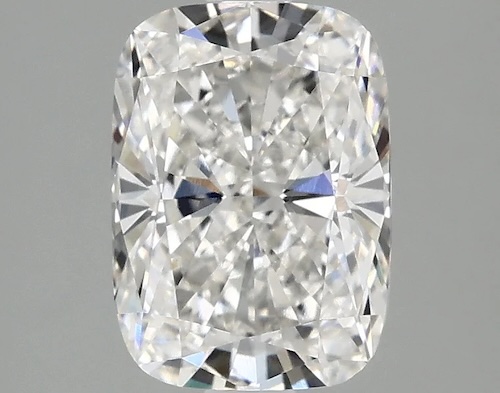
1.90 Carat Cushion Lab Grown Diamond from Brilliant Earth
They should not be treated as exactly the same thing as strain.
GIA research into CVD diamond growth has shown that impurity-related defects can develop differently across microscopic growth steps, producing striated patterns that are particularly useful to laboratories when identifying CVD-grown diamonds.
GIA has also documented CVD lab-grown diamonds showing clear growth striations under DiamondView luminescence imaging.
The important word here is imaging.
Many of the striking stripe patterns you see in technical articles are produced using specialist laboratory equipment.
You should not expect to open a normal 360-degree product video and literally see fluorescent stripes running across every problematic CVD diamond.
Instead, growth irregularities may sometimes manifest to the buyer as:
- Uneven transparency
- Oily or wavy graining
- A soft-looking area
- A slight haze
- Reduced visual crispness
GIA’s examination of a CVD-grown diamond weighing more than 34 carats found weak oily or wavy graining visible through the table. GIA noted that this characteristic tends to become more prominent in CVD diamonds with high strain and strong birefringence patterns.
That relationship between strain, graining, and visible transparency is what matters most when shopping.
Strain, Striations and Haziness Are Related but Not Identical
It is easy to see the terms strain, striations, graining, and haze used almost interchangeably online.
They describe different things.
| Term | What It Means |
|---|---|
| Strain | Internal stress or distortion within the diamond crystal lattice |
| Birefringence | Optical effect used by gemologists to reveal internal strain |
| Striations | Growth-related bands or patterns, particularly associated with CVD growth |
| Graining | Internal structural features related to crystal growth or deformation |
| Haziness | The visible reduction in transparency that a buyer may actually notice |
A diamond may display strain during specialist testing without looking visibly hazy.
Likewise, the presence of CVD growth striations does not automatically make a diamond unattractive.
The buyer should therefore concentrate on the visible outcome.
Can you see crisp facets through the diamond?
Does the stone look bright and transparent?
Does it maintain that crispness as it rotates?
Or does it appear to have a persistent translucent veil across part or all of the stone?
That is ultimately more important than trying to diagnose the exact crystallographic mechanism responsible.
This distinction is also why I caution against buying lab-grown diamonds entirely from grading-report specifications.
Read my lab diamond certification guide to understand what certificates can tell you and, just as importantly, what they cannot.
Can Strain Actually Make a Lab-Grown Diamond Look Hazy?
Yes, in some diamonds.
GIA has documented CVD-grown material where internal graining and high birefringence were associated with slightly hazy appearances. Earlier research into gem-quality CVD material found unusual internal graining, high birefringence, and a proportion of samples displaying visible haze.
More recent GIA observations demonstrate that modern production is capable of producing extremely high-quality CVD diamonds, so this should not be interpreted as meaning CVD diamonds are inherently hazy. CVD growth technology has improved enormously, including the production of large colorless and near-colorless gem diamonds.
Quality varies from crystal to crystal.
This is the key point.
A beautifully grown and expertly cut CVD diamond can have excellent transparency.
A poor-quality CVD diamond may show distracting graining or crystal distortion.
That is why I dislike blanket advice such as:
“CVD is bad, buy HPHT.”
The reality is more nuanced.
Evaluate the individual diamond.
My guide to untreated vs. treated lab-grown diamonds explores some of these crystal-quality considerations in more detail.
Does HPHT Have Less Strain Than CVD?
In general, strong strain-related birefringence is more characteristic of CVD material, while many HPHT-grown diamonds display comparatively little strain.
GIA has used the absence or relative lack of strain patterns as one of several characteristics when studying and identifying HPHT-grown synthetic diamonds.
But that does not mean every HPHT diamond is automatically superior.
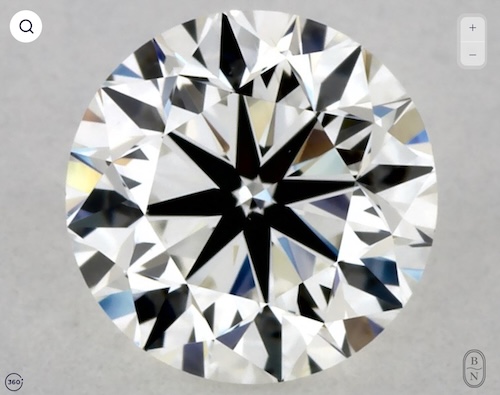
GIA 1.01 Carat H-VS2 Very Good Cut Round Diamond from Blue Nile
HPHT-grown diamonds can present their own characteristics, including:
- Metallic inclusions
- Blue or gray nuance in some material
- Phosphorescence
- Growth-sector patterns
- Differences in crystal quality
Nor is every HPHT diamond completely free of strain. GIA has examined HPHT-grown material using crossed polarizers specifically to assess anomalous birefringence caused by internal lattice strain.
The sensible buying conclusion is:
Do not choose a diamond solely because its certificate says HPHT or CVD.
Growth method is useful information, but the actual diamond matters much more.
For a deeper comparison, read my complete HPHT lab-grown diamond buying guide.
Can Post-Growth HPHT Treatment Remove CVD Problems?
CVD diamonds are sometimes subjected to HPHT treatment after growth.
This treatment is commonly used to improve color by changing certain defects within the crystal.
GIA has examined numerous HPHT-treated CVD diamonds and confirmed that post-growth processing can alter their color characteristics.
However, consumers should not assume:
HPHT-treated CVD = guaranteed perfect transparency.
Post-growth treatment does not turn every CVD diamond into an identical crystal.
A diamond still needs to be evaluated for:
- Transparency
- Cut quality
- Color
- Clarity
- Graining
- Visual performance
The treatment disclosure on a report is therefore useful information, but it does not replace looking at the stone.
If you want to understand the terminology appearing on laboratory paperwork, read my guide explaining how to read an IGI lab-grown diamond report and my comparison of IGI vs. GIA lab diamond grading.
How to Spot a Hazy Lab-Grown Diamond in a 360° Video
You cannot reliably diagnose microscopic crystal strain from an ordinary product video.
But you can look for signs that transparency may not be as good as it should be.
Start by viewing the actual diamond at high magnification.
When the diamond faces the camera, look through the table.
A transparent, well-cut diamond should normally show relatively crisp facet boundaries and clearly defined contrast.
Potential warning signs include:
- Facets that look strangely blurred through the center
- A whitish or gray veil that remains as the stone rotates
- Areas that look oily or smeared despite being in focus
- A generally sleepy appearance compared with similar diamonds
- Weak visual contrast despite apparently strong proportions
- A patch that stays cloudy from several viewing angles
The phrase “from several viewing angles” is important.
Diamond videos contain reflections, camera glare, depth-of-field effects, and studio lighting.
One strange frame proves very little.
Watch the entire rotation.
If a cloudy area disappears immediately as the diamond moves, you may simply be looking at a reflection.
If the same soft, milky appearance persists through multiple angles, I would investigate further.
Blue Nile itself recommends using high-resolution imagery and 360° video to examine diamonds from multiple angles when shopping online.
Compare the Diamond Against Another Stone Under Identical Lighting
One of the easiest ways to identify questionable transparency is comparison.
Looking at one diamond in isolation is difficult because you do not know how the retailer’s camera, lighting, and image processing normally look.
Instead, open two or three diamonds from the same retailer.
Try to keep the specifications relatively similar:
- Same shape
- Similar carat weight
- Similar color
- Similar clarity
- Similar cut quality
Then compare how crisp each diamond appears through its table.
If Diamond A looks exceptionally sharp and transparent while Diamond B appears slightly foggy under exactly the same photography setup, that difference deserves investigation.
This method will not provide a scientific strain diagnosis.
It simply helps you recognize when one crystal does not look as transparent as its peers.
This approach is particularly useful when searching very cheap lab-grown inventory, where an unusually low price can sometimes accompany compromises that are not obvious from the headline 4Cs.
Read my guide on why you should avoid some very cheap lab-grown diamonds before assuming that the lowest price is automatically the best deal.
A High Clarity Grade Does Not Guarantee Perfect Transparency
This is perhaps the most important buying lesson in this guide.
Clarity and transparency are related, but they are not identical.
A clarity grade primarily evaluates inclusions and blemishes according to their size, number, position, nature, and visibility under standardized grading conditions.
It does not give you a standalone numerical “transparency grade.”
GIA’s 2024 examination of a 3.14 carat CVD-grown oval provides a useful example. The diamond received an F-equivalent color and VVS2 clarity grade, yet it contained a dark growth band visible through several facets that locally affected its transparency.
That means filtering your search to:
VVS2 and above
does not automatically protect you from every potential crystal-quality issue.
Likewise, paying for VVS1 instead of VS1 does not necessarily give you a visibly brighter or more transparent diamond.
I would rather buy a completely transparent, beautifully cut VS1 than a technically higher-clarity diamond that looks slightly sleepy.
That is another reason the 4Cs should be treated as the starting point of your assessment rather than the entire assessment.
Don’t Confuse Poor Cut With Poor Transparency
A dull diamond is not necessarily a hazy diamond.
This distinction matters.
Poor transparency reduces the crispness with which light travels through the crystal.
Poor cut quality causes light to be handled inefficiently because of the diamond’s proportions and facet relationships.
The visual results can overlap.
Both diamonds may appear less lively.
But the causes are different.
A poorly cut diamond may have perfect crystal transparency yet leak substantial amounts of light through the pavilion.
A diamond with transparency problems could have theoretically excellent proportions but still appear less crisp than expected.
This is why I recommend assessing both independently.
Read my lab-grown diamond cut guide before purchasing.
For round diamonds, tools such as ASET and IdealScope can provide additional information about light return and leakage. Whiteflash, for example, currently provides ASET and IdealScope imagery for its round Precision Lab Grown diamonds alongside HD video.
However, a strong ASET image is not a strain test.
Use light-performance imaging to assess cut and video or physical inspection to assess transparency.