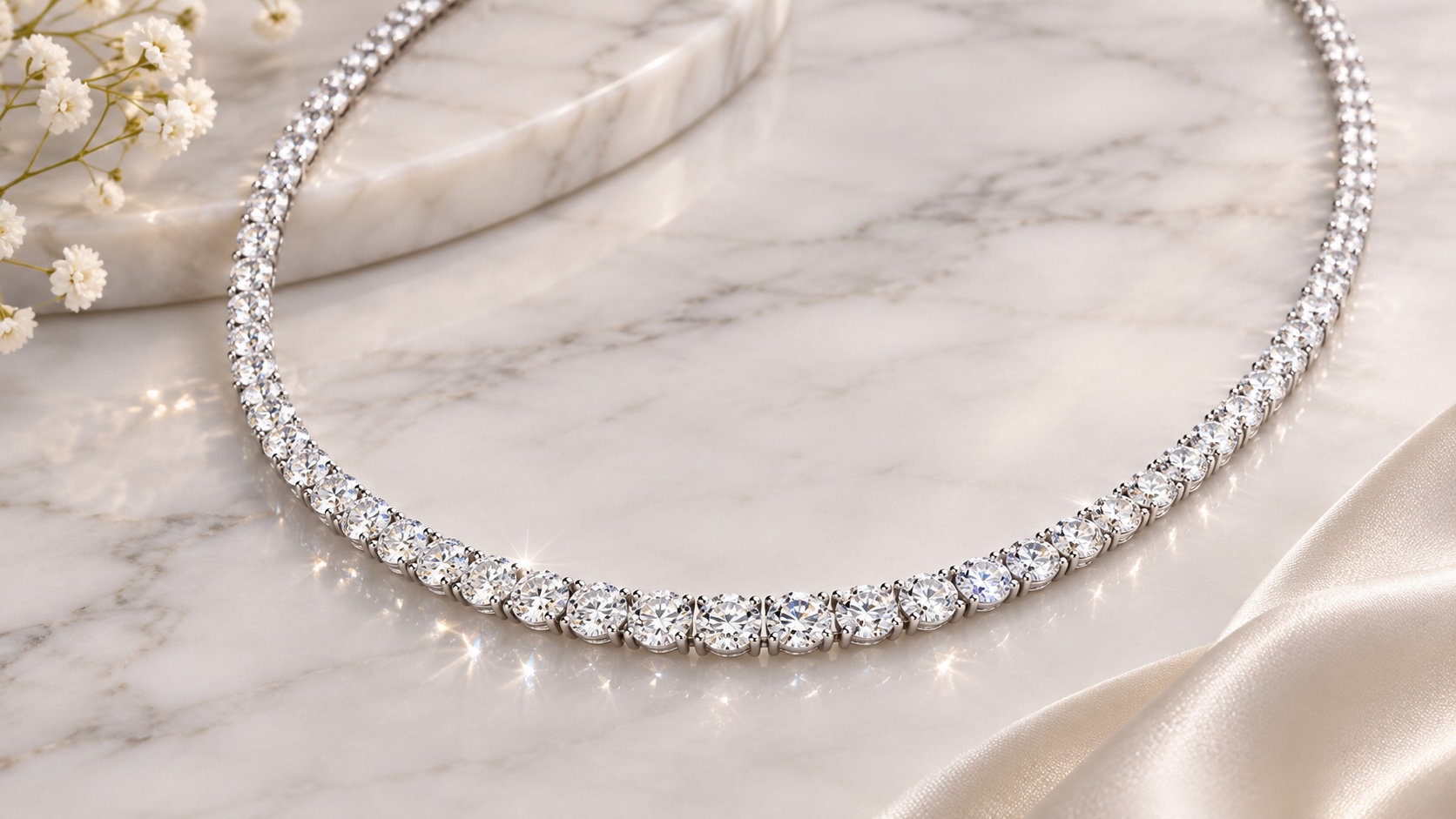
Lab-grown diamonds have made tennis necklaces far more accessible.
A natural diamond tennis necklace containing 10, 15, or 20 carats of diamonds can cost a considerable amount. Choosing lab-grown diamonds lets you achieve the same continuous line of real diamonds at a much lower price, making larger total carat weights much easier to consider.
But total carat weight should not be the only thing you compare.
A good tennis necklace also needs well-matched diamonds, secure settings, flexibility, a reliable clasp, and a length that sits correctly on the neck.
For most buyers, I would start with these four retailers:
| Rank | Retailer | Best For |
|---|---|---|
| 1 | Whiteflash | Diamond quality and matching |
| 2 | Brilliant Earth | Style and design choice |
| 3 | Blue Nile | Classic styles and carat-weight comparison |
| 4 | Ritani | Value and additional lab-grown choice |
1. Whiteflash: Best Overall
My first choice for a lab-grown diamond tennis necklace is Whiteflash.
Whiteflash is particularly appealing if you care more about the overall quality of the finished necklace than simply finding the biggest total carat weight for the lowest price.
Its lab-grown collection includes classic tennis necklaces in different:
Total carat weights
Necklace lengths
Prong styles
Gold colors
Graduated and full-eternity designs
That choice matters because a tennis necklace contains dozens of individual diamonds. They need to look consistent when viewed together.
A necklace made with bright, well-matched diamonds can look much better than a heavier necklace made with poorly matched stones.
Browse lab-grown diamond jewelry at Whiteflash if diamond quality and craftsmanship are the priorities.
You can also read my Whiteflash review for more on the retailer.
2. Brilliant Earth: Best for Style Choice
Brilliant Earth is the retailer I would look at if you want more variety in how the necklace actually looks.
Alongside conventional round-diamond tennis necklaces, its jewelry collection includes more distinctive styles such as:
Graduated necklaces
Bezel-set designs
Partial tennis necklaces
Different prong arrangements
Emerald-cut diamond necklaces
Higher-carat statement pieces
That makes Brilliant Earth particularly interesting if a traditional straight line of round diamonds feels too predictable.
There is also plenty of choice across different total carat weights, so you can move from something relatively understated to a much more substantial necklace without changing retailers.
For buyers prioritizing design, browse Brilliant Earth’s diamond jewelry and compare the necklace length and total carat weight as carefully as the style itself.
My Brilliant Earth review covers the wider shopping experience.
3. Blue Nile: Best for Comparing Classic Designs
Blue Nile is another good place to compare lab-grown tennis necklaces, particularly if you already know you want a traditional design.
Its large jewelry catalog makes it relatively easy to compare different:
Carat weights
Necklace lengths
Graduated styles
Metal choices
Diamond sizes
This is useful because total carat weight can be difficult to visualize.
A 5 carat necklace and a 10 carat necklace do not simply differ on paper. The individual diamonds generally become larger, giving the entire necklace significantly more presence.
Blue Nile is therefore a good retailer for establishing how much diamond coverage you actually want before deciding how much to spend.
Compare diamond jewelry at Blue Nile if you want a broad range of classic options across different price points.
You can also read my Blue Nile review.
4. Ritani: Worth Comparing for Value
Ritani is also worth adding to your shortlist when shopping for lab-grown diamond jewelry.
The retailer has built a strong reputation around lab-grown diamonds, competitive pricing, and comparison-led shopping.
That makes it particularly useful if you have already found a tennis necklace you like elsewhere and want another point of comparison before buying.
Ritani’s wider jewelry collection also includes:
Tennis jewelry
Diamond pendants
Station necklaces
Bracelets
Other lab-grown diamond pieces
I would use Ritani primarily to compare the overall value you are getting for your budget rather than automatically choosing whichever necklace has the largest advertised carat weight.
What Total Carat Weight Should You Choose?
Tennis necklaces are normally described using total carat weight, or CTW.
That number represents all the diamonds in the necklace combined.
A 10 CTW necklace does not contain ten 1 carat diamonds.
Instead, the total weight is divided among the dozens of diamonds that create the necklace.
As total carat weight rises, the individual diamonds generally become larger and the necklace becomes more visually substantial.
For many buyers, somewhere around 5 to 10 total carats offers a strong balance between everyday wearability and noticeable diamond coverage.
Higher-carat necklaces create much more of a statement.
Straight vs. Graduated Tennis Necklaces
This is largely a style decision.
A straight tennis necklace uses similarly sized diamonds around the necklace, creating a consistent line of sparkle.
A graduated tennis necklace uses increasingly larger diamonds toward the center.
Graduated designs naturally draw attention to the front of the necklace and can make a given total carat weight feel more dramatic.
If you are undecided, compare both styles at Whiteflash and Brilliant Earth.
What Diamond Quality Do You Need?
You usually do not need exceptionally high color or clarity grades.
Remember that each individual diamond is relatively small.
The priority should be a necklace where the stones look:
Bright
Clean to the eye
Consistent in color
Well matched
Properly cut
Paying significantly more for extremely high clarity grades usually provides very little visible benefit in this type of jewelry.
I would rather buy a well-made necklace with consistently bright diamonds than chase impressive specifications that cannot be seen without magnification.
Prong vs. Bezel Tennis Necklaces
Most traditional tennis necklaces use prongs.
Three-Prong
Three-prong settings expose plenty of each diamond and can produce a lighter, more delicate appearance.
Four-Prong
Four-prong settings create the classic tennis necklace look and provide a little more metal around each stone.
Bezel
Bezel settings surround each diamond with metal.
They create a more contemporary appearance and provide additional protection around the stones.
For something traditional, I would favor prongs.
For a more modern look, a bezel-set design from Brilliant Earth can be particularly attractive.
Pay Attention to Necklace Length
Do not overlook length.
Common tennis necklace lengths include roughly:
16 inches
17 inches
18 inches
Longer statement lengths
A shorter necklace sits higher around the neckline.
An 18-inch necklace falls lower and spreads the same total diamond weight over a greater circumference.
That means two 10 carat necklaces at different lengths may not look identical.
Consider where you want the necklace to sit before focusing entirely on CTW.
The Clasp Matters
A diamond tennis necklace is valuable enough that the clasp should be taken seriously.
Look for a secure clasp with appropriate safety mechanisms rather than treating it as an insignificant part of the design.
The necklace should also articulate naturally around the neck.
Poorly constructed tennis necklaces can twist or flip, preventing the diamonds from consistently facing outward.
This is one reason I would favor established jewelry retailers such as Whiteflash, Brilliant Earth, Blue Nile, and Ritani over buying solely on the lowest advertised price.
Lab-Grown vs. Natural Diamond Tennis Necklaces
Tennis necklaces are one of the categories where lab-grown diamonds make the biggest financial difference.
A necklace contains so many individual diamonds that natural diamond costs accumulate quickly.
Lab-grown diamonds let you increase:
Total carat weight
Individual diamond size
Necklace length
Overall visual impact
without approaching the cost of an equivalent natural diamond piece.
The trade-off is that lab-grown diamonds do not have the same natural rarity or long-term market characteristics as mined diamonds.
For someone buying primarily for appearance and wear, however, lab-grown tennis necklaces can offer excellent value.
Which Retailer Should You Choose?
For the strongest emphasis on diamond quality and matching, I would start with Whiteflash.
If design choice matters most, Brilliant Earth offers plenty of interesting alternatives to the standard tennis necklace.
For straightforward comparison between classic styles and total carat weights, Blue Nile is worth checking.
And Ritani gives you another useful comparison point, particularly if overall value is high on your list.
Frequently Asked Questions
Are lab-grown diamond tennis necklaces worth it?
They can offer excellent value if your priority is achieving substantial diamond coverage for your budget.
A comparable natural diamond necklace can cost significantly more.
How many carats should a tennis necklace be?
There is no correct amount.
Around 5 to 10 total carats can provide noticeable diamond coverage without becoming excessively large, while 15 carats and above creates a much more dramatic statement.
Can you tell a lab-grown tennis necklace from a natural one?
Not simply by looking at it.
Lab-grown and natural diamonds have the same fundamental crystal structure and very similar optical properties.
What is the best setting?
Three and four-prong settings provide the traditional tennis necklace appearance.
Bezel settings offer a more contemporary style and surround each diamond with additional metal.
Where is the best place to buy one?
My first choice is Whiteflash, followed by Brilliant Earth, Blue Nile, and Ritani.
Final Thoughts
A lab-grown diamond tennis necklace is one of the easiest ways to achieve substantial diamond presence without natural diamond pricing.
But do not shop by total carat weight alone.
The best necklace combines:
bright, well-matched diamonds, secure construction, good flexibility, a reliable clasp, and the right length for the wearer.
For quality, start with Whiteflash.
For design variety, compare Brilliant Earth.
For broad classic selection, look at Blue Nile.
And before committing, check Ritani as another useful comparison for lab-grown diamond jewelry.