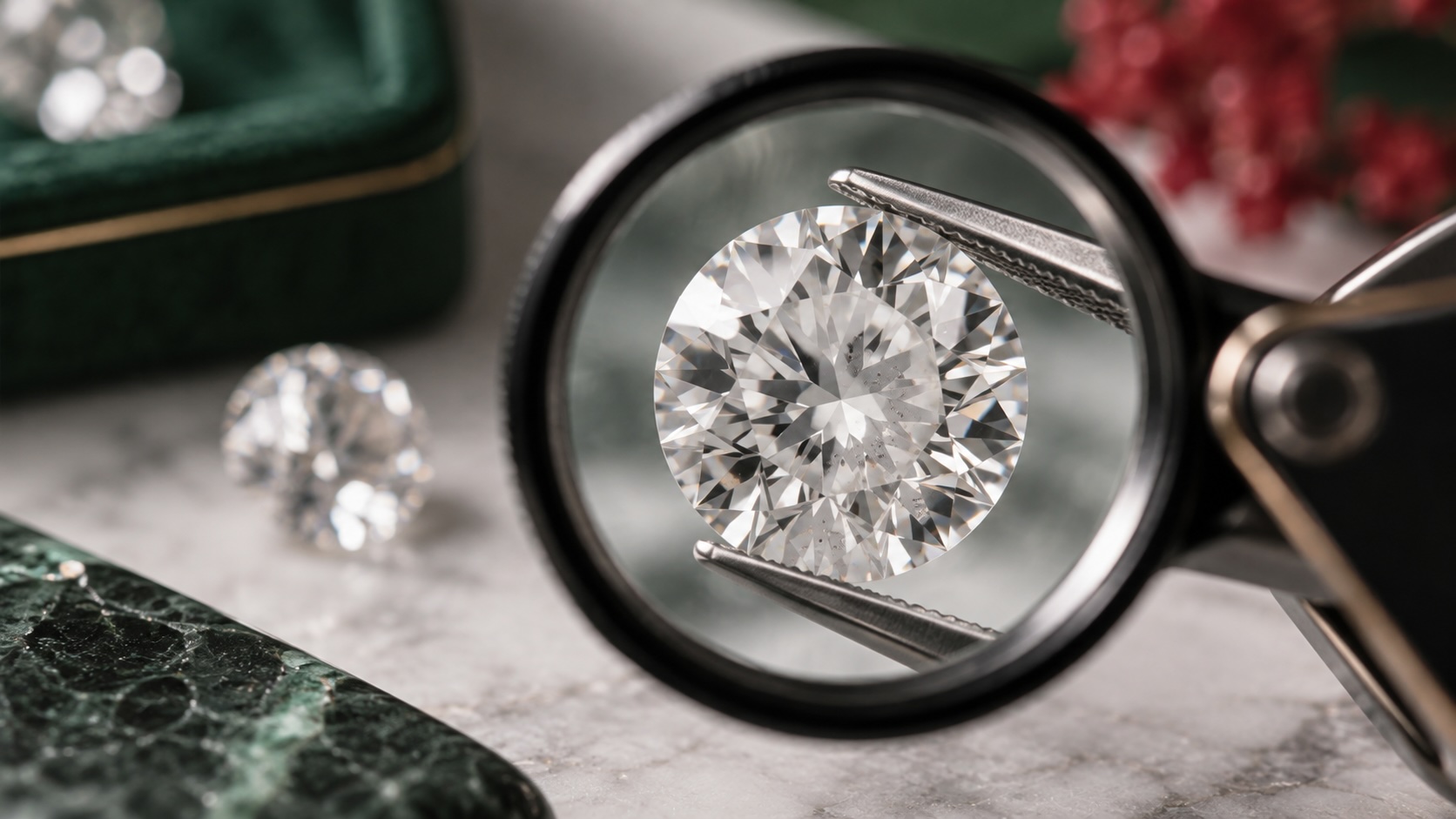
Lab-grown diamonds can receive the same familiar clarity grades as natural diamonds, but the types of inclusions inside them can be very different.
That is because laboratory-grown diamonds form through manufacturing processes rather than deep within the Earth.
Lab-grown diamonds can receive the same familiar clarity grades as natural diamonds, but the types of inclusions inside them can be very different.
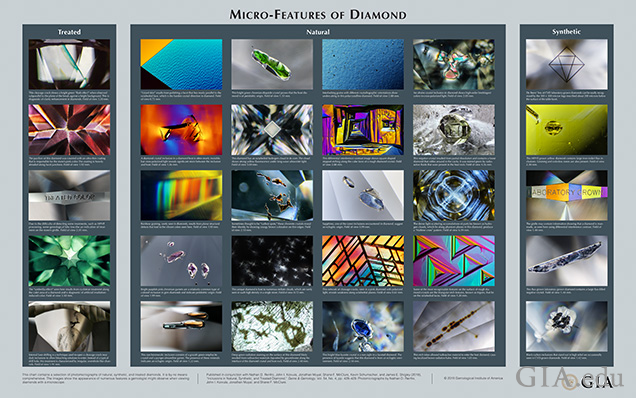
That is because laboratory-grown diamonds form through manufacturing processes rather than deep within the Earth.
Depending on whether the diamond was produced using HPHT, or High Pressure High Temperature, or CVD, Chemical Vapor Deposition, you may encounter characteristics such as:
- Metallic flux inclusions
- Graphite or other non-diamond carbon
- Growth remnants
- Pinpoints
- Clouds
- Needles
- Internal graining
- Growth-related strain
Some of these characteristics can be useful clues about how the diamond was grown. Others simply contribute to the stone’s clarity grade.
Most importantly:
An inclusion does not automatically make a lab-grown diamond bad.
A tiny inclusion that is invisible without magnification may have essentially no effect on how the diamond looks in an engagement ring.
The concern increases when inclusions become:
- Visible without magnification
- Numerous
- Centrally located
- Dark and high contrast
- Large enough to reduce transparency
- Associated with other growth-quality problems
My preference is therefore not to chase flawless laboratory-grown diamonds.
I want a diamond that is eye clean, transparent, well cut, and free from distracting growth characteristics.
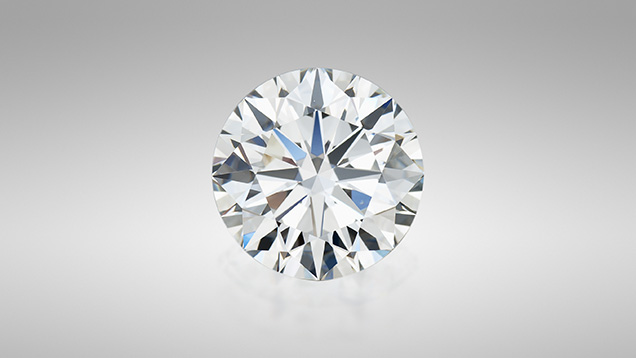
Diamonds such as this 1.15 ct round brilliant are some of the most highly sought-after gem materials and may contain inclusions that give the gemologist clues about their origin or treatment status.
If you are new to the subject, start with my guide to the 4Cs of diamonds and lab-grown diamond certification guide.
Lab-Grown Diamond Inclusions at a Glance
| Inclusion or Characteristic | More Common Association | Typical Appearance | Main Concern |
|---|---|---|---|
| Metallic flux | HPHT | Dark, reflective, metallic | Visibility |
| Graphite / non-diamond carbon | Often CVD | Black, gray, opaque | Visibility and transparency |
| Growth remnants | Lab-grown material generally | Irregular dark or transparent features | Depends on size and location |
| Pinpoints | HPHT or CVD | Tiny dots | Usually minor |
| Clouds | HPHT or CVD | Hazy grouping of microscopic inclusions | Transparency if severe |
| Needles | Possible in lab-grown diamonds | Thin elongated features | Usually appearance |
| Internal graining / strain | Particularly relevant to CVD material | Lines, bands, distortion | Transparency and visual crispness |
The growth method can make certain inclusion types more likely, but it should not be used as an automatic quality judgment.
An HPHT diamond can be exceptionally clean.
A CVD diamond can be exceptionally clean.
The individual diamond is what matters.
Why Do Lab-Grown Diamonds Have Inclusions?
A laboratory-grown diamond is still formed through crystal growth.
Atoms of carbon are added to a diamond seed until a larger crystal develops.
That process is highly controlled, but it is not necessarily perfect.
During growth, the crystal may incorporate:
- Trace metallic material
- Non-diamond carbon
- Microscopic foreign material
- Structural irregularities
- Growth disruptions
These can eventually appear as clarity characteristics in the polished diamond.
Natural diamonds also contain inclusions, but their inclusions originate from geological formation deep within the Earth.
This is why the inclusion patterns in natural and laboratory-grown diamonds can differ.
Gemological laboratories can use these differences, alongside sophisticated testing, to help identify diamond origin and growth method.
For consumers, however, the practical question is much simpler:
Does the inclusion affect appearance, transparency, durability, or value?
If the answer is no, there is usually little reason to worry about it.
What Are Metallic Flux Inclusions?
Metallic flux inclusions are most strongly associated with HPHT-grown diamonds.
HPHT growth recreates extremely high pressure and temperature conditions while using a molten metallic solvent or catalyst to help carbon crystallize around a diamond seed.
That growth environment can involve metals such as:
- Iron
- Nickel
- Cobalt
or related metallic alloys.
Small amounts of this metallic material can occasionally become trapped inside the growing diamond crystal.
The finished inclusion may appear:
- Dark
- Black
- Gray
- Reflective
- Metallic
under magnification.
This can look alarming in a 20x or 40x video.
But remember that high-resolution diamond imagery enormously enlarges microscopic characteristics.
The important question is whether the metallic inclusion is visible during normal viewing.
Are Metallic Inclusions Bad?
Not automatically.
A tiny metallic inclusion close to the edge of a diamond may be impossible to see without magnification.
If the stone is:
- Eye clean
- Transparent
- Well cut
- Structurally sound
I would not reject it solely because a microscopic metallic inclusion exists.
However, I become less enthusiastic when the inclusion is:
- Large
- Black
- Located under the table
- High contrast
- Easily visible without magnification
- Surrounded by additional inclusions
A dark inclusion in the middle of a large, high-color lab-grown diamond can be particularly distracting because the rest of the stone may be extremely clean.
Clarity should therefore be assessed visually, not simply from the letter grade.
Can HPHT Diamonds Be Magnetic?
Some HPHT-grown diamonds containing sufficient metallic material can show magnetic attraction.
This relates to metallic inclusions left from the growth environment.
It is an interesting gemological characteristic, but it is not something I would recommend consumers use as a buying test.
Not every HPHT-grown diamond contains enough metallic material to behave noticeably around a magnet.
And the absence of magnetic response does not prove the diamond was grown using CVD.
Your diamond’s laboratory report and professional identification are much more important.
The relevant buying question remains:
Can I see the inclusion, and does it affect the diamond’s appearance?
Does Metallic Flux Affect Durability?
A small metallic inclusion does not automatically make a diamond structurally weak.
For normal consumers, metallic inclusions are primarily a clarity and appearance consideration.
A tiny enclosed inclusion can remain safely inside the diamond.
As with any inclusion, I would pay more attention if it is:
- Very large
- Surface-reaching
- Associated with a fracture
- Located in a vulnerable area
But the mere presence of metallic material does not mean the diamond is going to crack.
Do not confuse:
visible inclusion
with:
durability problem.
They are separate issues.
[info_box title=”” image=”” animate=””]
Where I Recommend Buying Quality-Focused Lab-Grown Diamonds
For buyers who want more detailed quality assessment, I recommend starting with Whiteflash. Its Precision Lab collection focuses heavily on cut quality and overall visual performance rather than simply offering the lowest possible price per carat.
Blue Nile is useful if you want a much larger lab-grown inventory and the ability to compare diamonds with similar carat, color, and clarity specifications.
Brilliant Earth also offers an extensive lab-grown diamond selection and a large range of engagement ring settings.
Whichever retailer you choose, I recommend checking actual imagery, transparency, inclusions, and cut quality, rather than selecting from the certificate alone.
[/info_box]
What Are Graphite Inclusions?
Graphite is another form of carbon.
Both diamond and graphite are made from carbon, but the carbon atoms are arranged differently.
Diamond has an extremely strong three-dimensional crystal structure.
Graphite has a layered structure.
During laboratory diamond growth, small areas of non-diamond carbon can occasionally become incorporated into or remain within the developing crystal.
These inclusions can appear:
- Black
- Dark gray
- Opaque
- Irregular
under magnification.
Graphite and other forms of non-diamond carbon are particularly relevant when discussing CVD-grown diamonds, although inclusion types are not exclusively limited to one growth process.
Why Can CVD Diamonds Contain Graphite?
CVD diamond growth takes place in a chamber containing carbon-rich gas.
Energy is used to break down the gas so that carbon atoms can accumulate on a diamond seed.
Under the correct conditions, those atoms build diamond crystal.
But growth is complex.
Not every carbon atom necessarily becomes perfectly incorporated into the diamond lattice.
Non-diamond carbon may form during imperfect growth conditions.
Some of this material may become trapped within the finished diamond crystal and appear as dark inclusions.
This does not mean CVD is a poor growth process.
Modern CVD production can create exceptionally clean diamonds.
It simply means that the quality of the finished crystal depends on the quality and stability of the growth process.
Are Graphite Inclusions Easy to See?
They can be.
The main issue with graphite and other dark inclusions is contrast.
A black feature stands out strongly against a transparent diamond.
A tiny white inclusion may disappear among reflections.
A similarly sized black inclusion beneath the table may be much easier to notice.
Location therefore matters enormously.
Consider:
Diamond A
Small dark inclusion near the girdle.
Diamond B
Same-sized dark inclusion directly beneath the center of the table.
Diamond B may be much more visually distracting even if both receive the same overall clarity grade.
This is why I prefer examining the actual video rather than shopping only from:
VS1
or:
VS2
on the certificate.
Graphite vs. Metallic Inclusions
Metallic inclusions and graphite can both appear dark under magnification, which means shoppers may struggle to distinguish them visually.
But they arise from different materials and growth conditions.
Metallic Flux
Most strongly associated with the metal solvent or catalyst used during HPHT growth.
Graphite / Non-Diamond Carbon
Carbon that exists in a non-diamond form and can occur as a result of growth conditions, particularly in CVD material.
You do not necessarily need to identify which type you are seeing from a product video.
That is the laboratory’s job.
As a consumer, ask:
- Is the inclusion visible?
- Where is it?
- Is the diamond eye clean?
- Does the stone remain transparent?
- Does the inclusion affect durability?
Those answers have much more practical value.
What Are Growth Remnants?
“Growth remnant” is a broad term that can be used to describe material or features associated with the process through which the laboratory-grown diamond developed.
Depending on the stone and laboratory terminology, the appearance may vary considerably.
A growth remnant may appear:
- Dark
- Irregular
- Transparent
- Slightly reflective
and can differ from the mineral inclusions traditionally associated with natural diamonds.
The important point is that a growth remnant is connected with the diamond’s laboratory formation rather than geological formation.
Again, it should not automatically be interpreted as a defect that makes the diamond unsuitable for jewelry.
The practical importance depends on:
- Size
- Number
- Position
- Relief
- Visibility
A microscopic growth remnant in an otherwise beautiful VS diamond may have virtually no practical significance.
Why Inclusion Location Matters
The location of an inclusion can matter as much as its size.
A tiny black inclusion positioned directly beneath the table may attract the eye every time you look at the diamond.
A slightly larger inclusion near the outer edge may disappear into the surrounding reflections.
I generally divide the diamond into three broad areas.
Center
The most visually sensitive area.
Dark inclusions here are much more likely to be noticed.
Mid-Facet Area
Still important, although diamond scintillation can sometimes disguise small characteristics.
Near the Girdle
Often the easiest location in which to tolerate a small inclusion.
Edge inclusions can sometimes be concealed by the setting, although any significant structural inclusion should still be evaluated professionally.
Do not judge clarity solely by inclusion size.
Size + location + contrast determine how noticeable it becomes.
What Is Inclusion Relief?
Relief describes how strongly an inclusion contrasts with the surrounding diamond.
A black inclusion has high relief.
It may be tiny but immediately visible.
A transparent or whitish inclusion has lower relief and may blend more easily into the diamond.
This explains why two VS2 diamonds can look very different.
Diamond A
Several tiny low-relief inclusions.
Diamond B
One small black inclusion directly under the table.
Both may receive the same laboratory grade.
Yet Diamond B could be much easier to see.
For an engagement ring, I care about what the inclusion looks like in real life rather than simply how many inclusions appear on the report.
Are Lab-Grown Diamonds More Included Than Natural Diamonds?
Not necessarily.
Lab-grown diamonds can range from heavily included stones to extremely high clarity material.
You can easily find laboratory-grown diamonds graded:
- VVS1
- VVS2
- VS1
- VS2
and higher.
Likewise, natural diamonds exist across the entire clarity scale.
The key difference is not necessarily how many inclusions exist.
It is often what type of inclusions are present and how they formed.
Lab-grown inclusions can sometimes reveal characteristics associated with the manufacturing process.
Natural diamond inclusions can contain minerals or other material trapped during geological growth.
For buyers, however, clarity should still be approached practically.
You usually do not need a flawless diamond.
Do You Need VVS Clarity in a Lab-Grown Diamond?
Usually not.
Lab-grown diamond pricing can make VVS grades relatively inexpensive compared with equivalent natural diamonds.
That can encourage shoppers to think:
Why not just buy VVS?
There is nothing wrong with doing that.
But it does not automatically produce a more beautiful diamond.
An eye-clean VS2 can look identical without magnification.
And a VVS lab-grown diamond could still have:
- Poor cut
- Gray nuance
- Brown nuance
- Blue nuance
- Weak transparency
- Growth strain
that makes it less attractive overall.
I would rather buy:
F VS2 + exceptional cut + neutral color + excellent transparency
than:
D VVS1 + mediocre cut + gray appearance
even if the second certificate looks more impressive.
Can Inclusions Make a Lab-Grown Diamond Hazy?
Yes, if they are sufficiently numerous or extensive.
A single tiny inclusion normally has little effect on transparency.
But clusters of microscopic inclusions can sometimes create a cloudy or hazy appearance.
At that point, the issue becomes bigger than whether one individual mark is eye visible.
The entire diamond may appear:
- Milky
- Sleepy
- Less crisp
- Slightly foggy
This is why transparency deserves separate consideration from clarity grade.
A diamond can technically be eye clean but still look less crisp than a better-quality comparison stone.
My guide to lab-grown diamond strain and striations covers another group of growth-related characteristics that can influence apparent transparency.
What Are Pinpoint Inclusions?
Pinpoints are extremely small crystal or particle-like inclusions.
Individually, they may be difficult or impossible to see without magnification.
A handful of pinpoints often has little practical importance.
However, many pinpoints grouped together can form what is described as a cloud.
The word cloud can sound alarming.
Again, severity matters.
A tiny cloud detectable only at high magnification may be completely harmless.
A large, dense cloud can affect transparency and create visible haze.
The report terminology therefore needs to be interpreted alongside actual imagery.
What Are Clouds in Lab-Grown Diamonds?
A cloud is a grouping of microscopic inclusions.
The individual particles may be extremely difficult to distinguish.
Together, they can form a hazy region.
Clouds can range from:
completely insignificant
to:
visibly detrimental to transparency.
If “cloud” appears among minor clarity characteristics in an otherwise crisp VS diamond, I am unlikely to worry automatically.
If a lower-clarity diamond looks hazy throughout and clouds are prominent in the clarity information, I would be much more cautious.
The eye test matters.
Can Growth Inclusions Affect Light Performance?
Small inclusions generally do not determine light performance.
Cut quality does.
Facet angles, proportions, symmetry, and optical precision control how efficiently the diamond returns light.
But there is an important exception.
If inclusions or growth defects become severe enough to reduce transparency, then they can interfere with the crispness of the light passing through the stone.
This is why the best lab-grown diamonds combine:
excellent cut + strong transparency + attractive color + sensible clarity.
Do not sacrifice cut simply to obtain microscopic perfection.
The 4Cs guide provides a useful framework, but lab-grown diamonds also benefit from closer examination of material quality.
Metallic Flux and HPHT Lab Diamonds
HPHT diamonds are grown under extremely high pressure and temperature.
The process can produce very high-quality diamonds.
Potential HPHT-related characteristics may include:
- Metallic flux inclusions
- Growth sectors
- Certain color zoning
- Boron-related blue nuance in some stones
None of these should be treated as universal.
Many HPHT diamonds are:
- Visually clean
- Highly transparent
- Neutral in color
- Extremely well suited to jewelry
My HPHT lab-grown diamond guide explains the growth process in much greater detail.
The key is to judge the finished diamond, not reject it because the letters HPHT appear on the report.
Graphite and CVD Lab Diamonds
CVD growth uses a very different environment.
Carbon is deposited onto a seed crystal layer by layer.
Potential CVD-related characteristics can include:
- Non-diamond carbon
- Graphite-like dark inclusions
- Growth striations
- Strain
- Brown or gray nuance in some material
Again, modern CVD growth can produce exceptionally attractive stones.
A high-quality CVD diamond can be preferable to a mediocre HPHT diamond.
And vice versa.
The growth method is useful information.
It is not a quality grade.
[info_box title=”” image=”” animate=””]
Compare Complete Diamonds, Not Just Clarity Grades
I particularly like Whiteflash Precision Lab diamonds for buyers who want a quality-focused approach to lab-grown diamonds, particularly where cut performance and detailed evaluation are priorities.
Blue Nile provides considerably more inventory and is useful for comparing diamonds with the same nominal clarity grade to see how their actual inclusions differ.
Brilliant Earth is another major lab-grown retailer with a large selection of diamonds and engagement ring settings.
For a broader comparison, see my guide to the best lab-grown diamond retailers.
Do not assume two VS2 diamonds are equivalent. Look at where the inclusions are, how dark they are, and whether they affect transparency or normal face-up appearance.
[/info_box]
Can You Identify Inclusions From a 360° Video?
A good rotating video can reveal a lot.
For dark inclusions, look for marks that:
- Remain fixed inside the diamond
- Move consistently with the stone
- Appear from several viewing angles
A dark reflection behaves differently.
It changes as the diamond rotates and lighting geometry changes.
This distinction is important because shoppers sometimes identify normal contrast as a black inclusion.
Well-cut diamonds naturally contain:
- Bright facets
- Dark facets
- Moving contrast
That is what creates scintillation.
A real inclusion stays in a fixed physical location inside the diamond.
If you are unsure, ask the retailer to inspect the stone.
Magnification Can Make Good Diamonds Look Terrible
Modern online diamond videos are extremely useful, but they create a psychological trap.
A tiny inclusion can fill your laptop screen.
You might think:
How could anyone buy that diamond?
Then the actual stone arrives and you cannot locate the inclusion with your unaided eye.
Always remember the scale.
A 1 carat round diamond is approximately 6.5 mm across when well proportioned.
Your product video may display it at:
150 mm across
or more on screen.
That means microscopic inclusions are being dramatically enlarged.
Use magnification to identify characteristics.
Do not confuse magnification with normal viewing.
What Does Eye Clean Mean?
An eye-clean diamond has no inclusions visible to the unaided eye under defined normal viewing conditions.
However, retailers can use different definitions.
You should consider:
- Viewing distance
- Lighting
- Face-up only vs. all angles
- Normal eyesight
- Whether you know where the inclusion is
Someone examining the diamond from 3 inches away after memorizing the inclusion location may see something another person never notices.
For most engagement-ring buyers, the useful standard is:
Does the diamond look clean during ordinary wear?
If yes, there is usually little reason to pay significantly more just to improve the clarity grade.
Should You Buy SI-Clarity Lab-Grown Diamonds?
Possibly, but I become more selective.
Because lab-grown diamonds are relatively affordable, the savings between SI and VS clarity may not justify accepting obvious inclusions.
This is particularly true with larger stones.
A dark central inclusion may become increasingly visible as the diamond gets larger.
For most lab-grown purchases, VS clarity often provides an excellent balance.
But I would happily choose an eye-clean SI diamond if:
- The inclusion is harmless
- The diamond is transparent
- The cut is excellent
- The stone offers strong value
I would not reject it simply because the certificate says SI.
Large Lab Diamonds Make Inclusion Selection More Important
The bigger the diamond, the easier some inclusions become to see.
Lab-grown pricing has made 2, 3, 4 carat and larger diamonds accessible to far more consumers.
But a huge diamond magnifies both strengths and weaknesses.
In a 4 carat stone:
- A dark inclusion may be easier to notice
- Gray or brown nuance may become more obvious
- Transparency problems can become more apparent
- Poor cut becomes difficult to ignore
My guide to large lab-grown diamonds explains why bigger is not automatically better.
I would rather own a slightly smaller, beautifully clean and transparent diamond than chase maximum carat weight at the expense of quality.
Do Different Diamond Shapes Hide Inclusions Differently?
Yes.
Round Brilliant
Round brilliants have a complex facet pattern and substantial scintillation.
This can make them excellent at disguising small inclusions.
Oval, Pear and Marquise
Brilliant faceting can hide many inclusions, although larger dark characteristics may remain visible.
Cushion and Radiant
Busy facet patterns can disguise inclusions effectively, particularly in stones with more fragmented reflections.
Emerald and Asscher
These are much less forgiving.
Large open step facets create a clear view into the diamond.
A black inclusion that disappears inside a round brilliant may be obvious through an emerald cut.
For step cuts, I am therefore more likely to choose a higher clarity grade.
Are Metallic Inclusions More Visible in Emerald Cuts?
Potentially.
The broad, open facets of emerald and Asscher diamonds make internal characteristics easier to observe.
That means dark metallic or graphite-like inclusions can be particularly distracting.
When buying a large lab-grown emerald cut, I prioritize:
- Eye cleanliness
- Transparency
- Neutral color
- Attractive step pattern
over chasing unnecessary headline specifications.
A beautiful VS1 could easily be preferable to a VVS diamond with weak transparency or unattractive nuance.
Can Inclusions Be Removed?
Once a finished diamond contains an internal inclusion, it cannot simply be cleaned out.
The inclusion is physically inside the crystal.
Theoretically, a cutter could repolish or recut a diamond to remove an inclusion close to the surface.
But that sacrifices carat weight and changes the diamond’s proportions.
This is not something an ordinary consumer should plan around.
If an inclusion bothers you before purchase:
choose another diamond.
Lab-grown inventory is large enough that there is usually little reason to compromise.
Are Growth Remnants Evidence the Diamond Is “Fake”?
No.
Growth remnants and manufacturing-related inclusions do not make a lab-grown diamond a simulant.
A laboratory-grown diamond is still crystalline diamond.
It has the fundamental optical and physical properties of diamond.
The difference is origin.
Lab-grown diamonds are produced using controlled technology.
Natural diamonds formed through geological processes.
Simulants such as:
- Cubic zirconia
- Moissanite
are different materials entirely.
An inclusion related to laboratory growth is simply evidence of the environment in which the diamond formed.
Do Lab-Grown Diamond Inclusions Affect Resale Value?
Clarity can influence value, but the wider lab-grown diamond market should also be considered.
Lab-grown diamond prices have fallen significantly over time as production has expanded and technology has improved.
That makes traditional natural-diamond-style resale expectations inappropriate for many lab-grown purchases.
My guide asking whether lab-grown diamonds are worth anything examines this issue in more detail.
I would therefore choose a lab-grown diamond primarily because:
- You love how it looks
- It fits your budget
- It delivers the size and quality you want
rather than selecting microscopic clarity characteristics based on future resale speculation.
Metallic Flux vs. Graphite vs. Growth Remnants
The easiest way to understand the three is:
Metallic Flux
Foreign metallic material associated particularly with the HPHT growth environment.
Main concern: dark visibility if large or centrally located.
Graphite / Non-Diamond Carbon
Carbon that did not form the normal diamond crystal structure, often discussed particularly in relation to CVD growth.
Main concern: dark visible inclusions and possible transparency issues if extensive.
Growth Remnants
Broader growth-related features or material associated with laboratory formation.
Main concern: depends entirely on size, location, and visibility.
None should automatically disqualify a diamond.
My Lab-Grown Inclusion Buying Checklist
Before buying a lab-grown diamond, I would ask:
Is It Eye Clean?
If the inclusion cannot be seen during normal viewing, it may have little practical importance.
Where Is the Inclusion?
Central dark inclusions concern me more than similar characteristics near the girdle.
Is It Dark?
High-relief black inclusions are usually easier to see.
Is It Large?
Always interpret magnification relative to the diamond’s actual physical size.
Are There Many Inclusions?
Numerous microscopic inclusions can potentially affect transparency.
Does the Diamond Look Hazy?
Evaluate transparency separately from the clarity grade.
Is the Diamond Well Cut?
Cut quality remains the most important factor in brilliance and sparkle.
Is the Body Color Neutral?
Also check for blue, brown, or gray nuance.
Has the Diamond Been Properly Graded?
Review the report and understand what it tells you.
My guide on how to read an IGI report can help.
Can the Retailer Inspect It?
For an expensive diamond, an actual human assessment can be extremely valuable.
When I Would Buy a Lab Diamond With Metallic Flux
I would consider it if:
- The inclusion is microscopic
- It is not visible without magnification
- It does not reduce transparency
- The diamond is otherwise excellent
- It is safely enclosed
- Cut performance is strong
I would not reject an attractive HPHT diamond simply because a tiny metallic inclusion can be found under extreme magnification.
When I Would Avoid Metallic Inclusions
I would normally avoid the stone when:
- A black metallic inclusion is visible face-up
- It sits directly under the table
- Multiple inclusions create distracting contrast
- The diamond has poor transparency
- Comparable cleaner diamonds are readily available
There is little reason to compromise heavily when the lab-grown market provides so much choice.
When I Would Buy a Diamond With Graphite
Again, small and invisible is usually fine.
I would consider the diamond if:
- The graphite is microscopic
- The stone remains eye clean
- Transparency is excellent
- The overall material quality is strong
- Cut quality is excellent
The name of the inclusion should not frighten you more than its actual appearance warrants.
When I Would Avoid Graphite
I would generally move on when:
- A black inclusion is easy to see
- Several graphite features are clustered together
- The diamond looks hazy
- The feature dominates the center of the stone
- Cleaner alternatives cost little more
Do not buy a visibly included diamond simply because the certificate has attractive color and carat specifications.
Frequently Asked Questions
What are metallic flux inclusions?
Metallic flux inclusions are small amounts of metallic material that can become trapped inside some HPHT-grown diamonds during crystal growth.
Are metallic inclusions bad?
Not necessarily.
Tiny metallic inclusions that are invisible without magnification may have virtually no effect on normal appearance.
What metals can occur in HPHT diamonds?
HPHT growth processes commonly involve metallic solvent or catalyst systems that can contain metals such as iron, nickel, or cobalt.
What are graphite inclusions?
Graphite inclusions are areas of non-diamond carbon that can become incorporated into a lab-grown diamond.
They may appear dark or black under magnification.
Are graphite inclusions common in CVD diamonds?
Non-diamond carbon is one of the inclusion types associated with CVD growth, although modern CVD diamonds can also be extremely clean.
What is a growth remnant?
Growth remnant is a broad term referring to features or material associated with the laboratory diamond growth process.
Its significance depends on the individual diamond.
Do inclusions make lab-grown diamonds weaker?
Not necessarily.
Most small inclusions are primarily clarity characteristics.
Large, surface-reaching, or fracture-related inclusions deserve separate durability assessment.
Can metallic inclusions make a diamond magnetic?
Some HPHT-grown diamonds containing sufficient metallic inclusions can respond to a magnet, but this is not something consumers should rely on for identification.
Are black inclusions bad?
They can be visually distracting because their high contrast makes them easier to see.
A tiny black inclusion near the edge may still be completely acceptable.
Do lab diamonds have different inclusions from natural diamonds?
They can.
Growth-related features in laboratory-grown diamonds reflect HPHT or CVD formation conditions rather than geological growth deep within the Earth.
Does VVS mean a lab diamond is automatically better?
No.
A VVS diamond may have fewer clarity characteristics, but cut, transparency, body color, and other growth-quality factors still matter enormously.
Is VS clarity good enough for lab-grown diamonds?
Frequently, yes.
A clean VS1 or VS2 can provide exactly the same normal viewing appearance as a VVS diamond.
Can inclusions reduce sparkle?
Minor inclusions normally have little effect on sparkle.
Severe inclusions or growth defects that reduce transparency can make the diamond look less crisp.
Final Verdict: Should You Worry About Lab-Grown Diamond Inclusions?
Lab-grown diamonds can contain inclusions that reflect the environment in which they were created.
HPHT-grown diamonds may contain metallic flux inclusions.
CVD-grown diamonds may contain graphite or other non-diamond carbon and growth-related characteristics.
Both growth methods can also produce extremely clean diamonds.
The mistake is assuming that the name of an inclusion automatically tells you whether the stone is good or bad.
Instead, ask:
- Can I see it?
- Where is it?
- Is it dark?
- Does it affect transparency?
- Does it affect durability?
- Is the diamond otherwise beautifully cut?
For most buyers, a small microscopic inclusion should matter far less than:
cut quality, transparency, overall color, and actual visual performance.
That is why I generally like eye-clean VS clarity for lab-grown diamonds.
It can provide all the visible beauty of much higher clarity without paying for microscopic perfection you will never see.
Use my 4Cs guide to understand clarity alongside the other quality factors, my IGI report guide to interpret grading information, and my guide to strain and striations to understand additional laboratory growth characteristics.
For retailers, I recommend starting with Whiteflash if quality-focused selection and cut performance matter most, Blue Nile for a much broader selection, and Brilliant Earth for another major range of lab-grown diamonds and settings.
The rule to remember is simple:
Do not pay for a flawless certificate. Pay for a diamond that looks flawless to you.