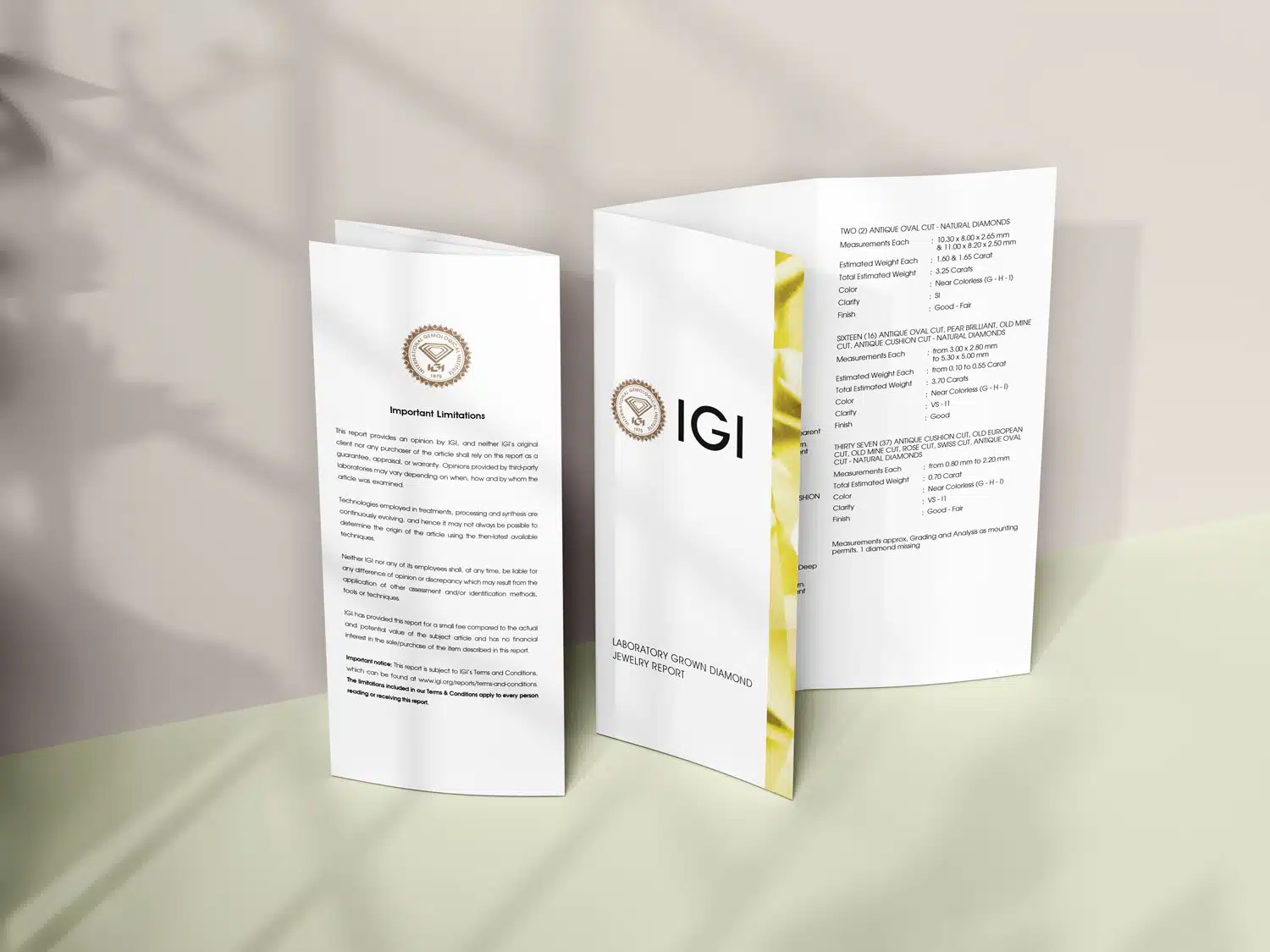
How to Read an IGI Lab-Grown Diamond Report

by Tom Thornbridge

An IGI lab-grown diamond report contains far more than a collection of grades. It confirms that the stone is a laboratory-grown diamond, records its dimensions and quality characteristics, and provides information that can help you compare it with other diamonds.

Understanding the report has become particularly important following GIA’s changes to lab-grown diamond grading. Since October 2025, GIA has classified eligible colourless and near-colourless lab-grown diamonds as either Premium or Standard, rather than assigning the precise colour and clarity grades traditionally used for natural diamonds. IGI, meanwhile, has reaffirmed its commitment to providing full 4Cs grading for both natural and lab-grown diamonds.

This means an IGI report can give buyers more granular information when comparing individual lab-grown diamonds. However, no grading report can tell you everything about how attractive a diamond will look. You still need to evaluate cut precision, transparency, tint and light performance before making a purchase.

Key Takeaways

  • IGI reports identify the diamond as laboratory-grown and provide detailed 4Cs grades.
  • Check that the report number matches the laser inscription on the diamond.
  • Cut quality should usually be prioritised above extremely high colour or clarity grades.
  • Growth method and post-growth treatments may appear in the comments section.
  • GIA now uses broader Premium and Standard classifications for eligible lab-grown diamonds.
  • An IGI report is useful, but images, videos and light-performance analysis are still important.

For a broader introduction, read our guide to lab-grown diamond certification.

What Is an IGI Lab-Grown Diamond Report?

An IGI Laboratory Grown Diamond Report is an independent assessment produced by the International Gemological Institute. IGI began grading lab-grown diamonds in 2005 and has become one of the most widely used laboratories within the lab-grown diamond market.
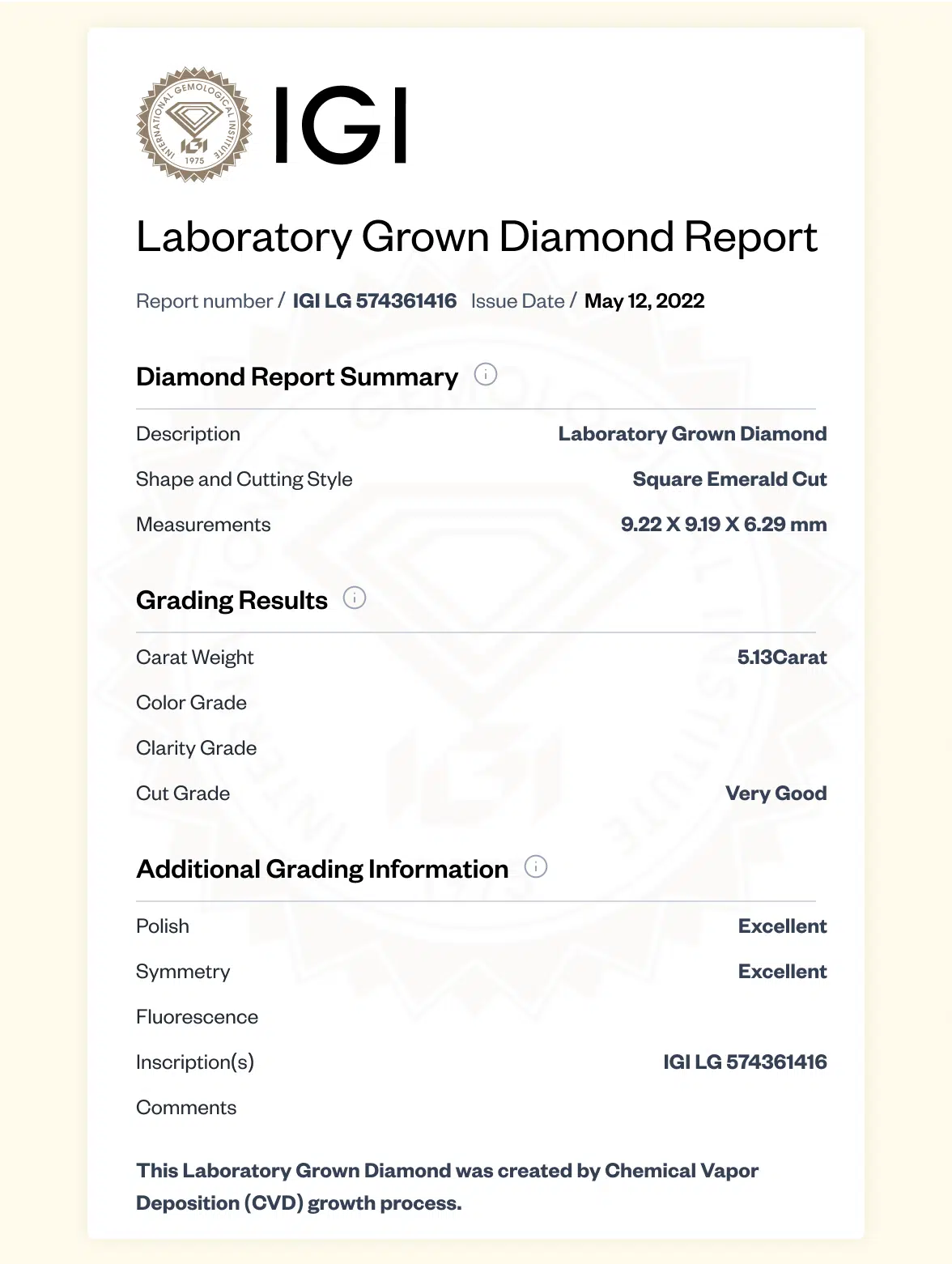
The report normally includes:

  • Confirmation that the diamond is laboratory-grown
  • The report number
  • Shape and cutting style
  • Measurements
  • Carat weight
  • Colour grade
  • Clarity grade
  • Cut grade, where applicable
  • Polish
  • Symmetry
  • Fluorescence
  • Proportion information
  • Comments about growth method or treatments
  • A clarity-characteristics diagram on some reports

Technically, this is a grading report rather than a guarantee of value. The term “IGI certificate” is commonly used by retailers and shoppers, but the document describes the diamond’s assessed characteristics. It does not establish a retail price or guarantee that the diamond is beautiful.

You can learn more about the laboratory in our dedicated IGI lab diamond certification guide.

How to Read an IGI Lab-Grown Diamond Report Step by Step

1. Report Number

Every IGI report has a unique report number. This number connects the physical diamond to its digital grading information.

Enter the number into IGI’s online report-verification service before buying. This allows you to confirm that the report exists and that the information shown by the retailer matches IGI’s records.
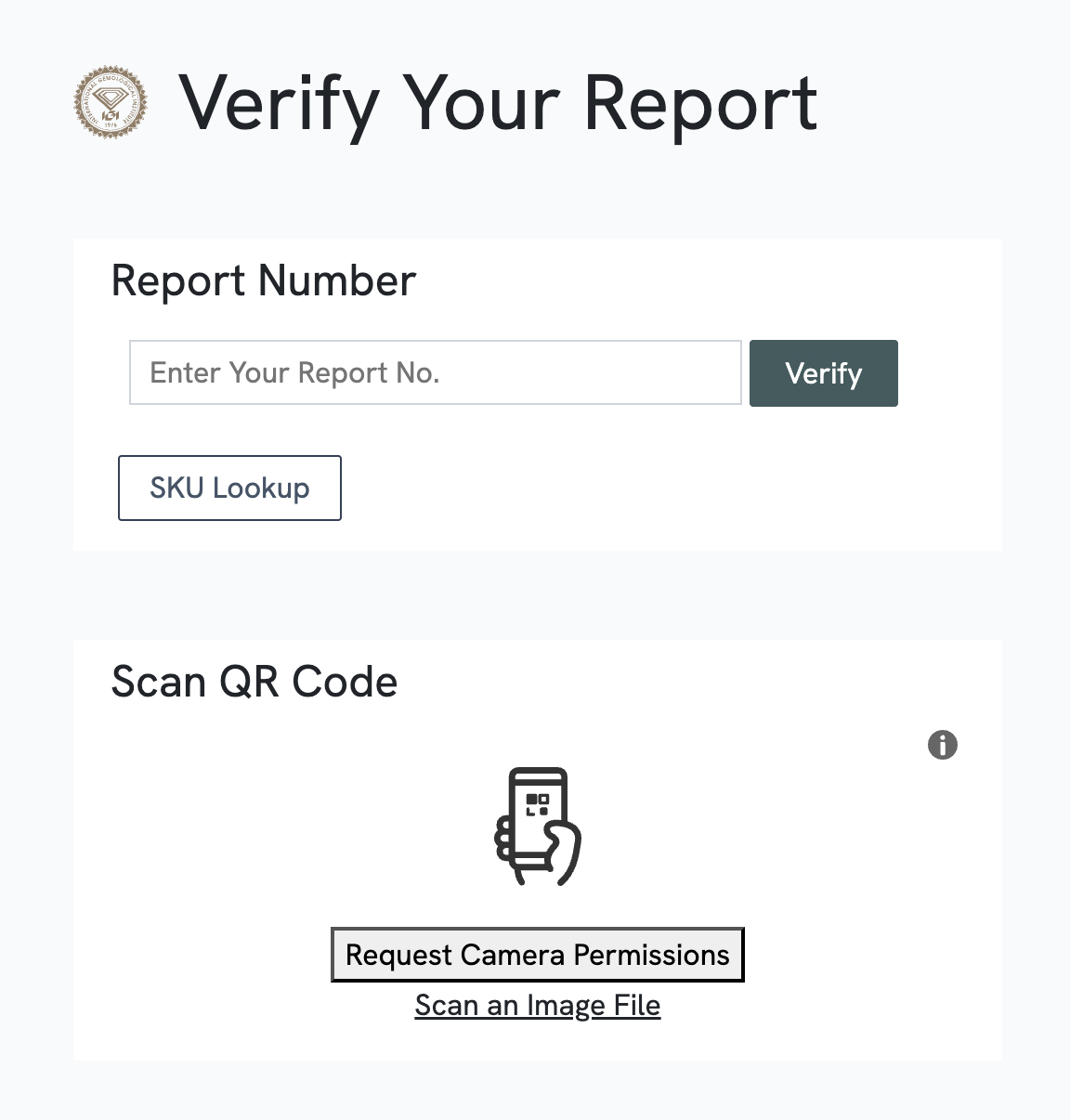
The same number is commonly laser-inscribed on the diamond’s girdle. Ask the retailer to confirm that the inscription has been checked before shipping.

A laser inscription is extremely small and normally requires magnification to read. It should not affect the appearance of the diamond.

2. Description and Laboratory-Grown Identification

The report should clearly identify the stone as a laboratory-grown diamond.

This is one of the most important parts of the document. Lab-grown diamonds have essentially the same fundamental chemical and physical characteristics as natural diamonds, but they are created in a controlled manufacturing environment rather than formed underground.

Do not confuse a laboratory-grown diamond with a diamond simulant. Cubic zirconia and moissanite may resemble diamonds, but they are different materials. An IGI report confirms that the graded stone is a diamond and identifies its laboratory-grown origin.

3. Growth Process and Treatments

Lab-grown diamonds are primarily produced using one of two methods:

  • Chemical Vapour Deposition, or CVD
  • High Pressure High Temperature, or HPHT

The growth process, along with the presence of post-growth treatments, may be disclosed within the report’s comments. IGI states that the growth process and treatments can be noted upon request.

A treatment is not automatically a reason to reject a diamond. HPHT treatment, for example, may be used to improve the colour of a CVD-grown diamond. The important point is transparency.

Growth method alone does not determine whether a diamond is attractive. Both processes can produce excellent diamonds, while both can also produce stones with tint, strain, haziness or other visual issues.

Our HPHT vs CVD lab diamonds guide explains the differences in more detail.

4. Shape and Cutting Style

This section describes the diamond’s outline and facet arrangement.

Common examples include:

  • Round brilliant
  • Oval brilliant
  • Cushion modified brilliant
  • Emerald cut
  • Pear brilliant
  • Radiant cut
  • Princess cut

Shape and cutting style are related, but they are not the same thing. “Oval” describes the outline, while “oval brilliant” describes how the facets have been arranged.

Modified brilliant cuts may contain additional facets. This is common in cushions, radiants and some other fancy shapes. The wording does not necessarily indicate higher or lower quality.

5. Measurements

The measurements describe the physical dimensions of the diamond in millimetres.

A round diamond may be shown in a format such as:

7.10 × 7.14 × 4.32 mm

The first two figures represent the minimum and maximum diameter. The final figure represents depth.

Fancy-shaped diamonds are normally listed as:

Length × width × depth

Measurements help you understand how large the diamond will appear. Two diamonds with the same carat weight can face up very differently depending on their proportions.

For elongated shapes, divide the length by the width to calculate the length-to-width ratio. For example:

10.00 ÷ 7.00 = 1.43

Whether that ratio is desirable depends on the shape and your personal preference. Some buyers prefer a longer oval or radiant, while others prefer a rounder outline.

6. Carat Weight

Carat is a measure of weight, not a direct measurement of visible size. One carat equals 200 milligrams.

1.01 ct D VVS1 Round Cut Precision Lab Grown Diamond from Whiteflash

A heavier diamond does not always look larger. A poorly proportioned diamond may carry excessive weight in its depth, causing it to appear smaller from above than a lighter, better-proportioned stone.

Always compare carat weight with:

  • Face-up measurements
  • Total depth
  • Shape
  • Cut quality
  • Visual appearance

Our diamond size guide provides examples of how different carat weights can appear.

7. Colour Grade

IGI continues to grade colourless and near-colourless lab-grown diamonds using the familiar D-to-Z colour scale.

  • D to F: Colourless
  • G to J: Near-colourless
  • K to M: Slightly tinted
  • N and below: Increasingly noticeable colour

IGI grades colour in a controlled viewing environment, with multiple graders independently assessing the diamond.

A higher colour grade does not automatically make a diamond more beautiful. Many G or H lab-grown diamonds appear colourless once set, particularly in smaller sizes and round brilliant cuts.

The type of colour also matters. Some lab-grown diamonds display grey, brown or blue nuance that may not be fully communicated by the letter grade. Review a high-quality video rather than relying only on the report.

Read our full guide to lab-grown diamond colour before deciding how high you need to go.

8. Clarity Grade

Clarity describes inclusions inside the diamond and blemishes on its surface. IGI evaluates clarity under 10× magnification.

The principal grades are:

  • FL: Flawless
  • IF: Internally Flawless
  • VVS1 and VVS2: Very, Very Slightly Included
  • VS1 and VS2: Very Slightly Included
  • SI1 and SI2: Slightly Included
  • I1, I2 and I3: Included

Most buyers do not need an IF or VVS lab-grown diamond. A well-chosen VS1 or VS2 diamond will often be completely eye-clean and can offer better value.

However, the location and nature of the inclusions matter. Watch for:

  • Dark inclusions beneath the table
  • Large inclusions near the centre
  • Clouds that reduce transparency
  • Inclusions extending to the surface
  • Feathers close to vulnerable corners
  • Features that may interfere with light performance

A clarity grade does not always capture wider crystal-quality issues such as strain or haziness. This is why video inspection remains important.

9. Cut Grade

Cut quality has the greatest influence on a diamond’s brightness, fire and sparkle.

For round brilliant diamonds, IGI assesses how the proportions and facet relationships contribute to brightness, fire, scintillation and pattern. IGI also uses a shape-specific assessment system for fancy-shaped diamonds.

Do not assume that every diamond labelled “Excellent” or “Ideal” will perform identically. These grades cover a range of proportions, and two diamonds with the same grade may display noticeably different levels of light return and optical symmetry.

For round diamonds, examine:

  • Table percentage
  • Total depth
  • Crown angle
  • Pavilion angle
  • Girdle thickness
  • Optical symmetry
  • Light leakage

For fancy shapes, also consider shape-specific problems such as:

  • Bow ties in ovals, pears and marquises
  • Dark centres in poorly cut emerald cuts
  • Uneven brightness in cushions
  • Windowing or weak contrast patterns

Our lab diamond cut guide explains why the grade on the report is only the beginning of a proper cut assessment.


 

Where to Buy IGI-Certified Lab-Grown Diamonds

Whiteflash is my leading choice for buyers who prioritise cut precision and transparency. Its Precision Lab diamonds are supported by detailed videos and advanced light-performance images, including ASET, IdealScope and Hearts and Arrows imaging on qualifying stones.

Blue Nile is a strong option for selection. Its large online inventory makes it easier to compare different shapes, sizes and price points. Check the individual grading report, as the grading laboratory can vary between diamonds.

Brilliant Earth is particularly appealing to shoppers who want a broad selection of lab-grown diamonds combined with distinctive engagement-ring settings. Open the report for each diamond and assess the stone itself rather than relying only on retailer filters.

Compare IGI reports, but make cut quality and actual appearance your final deciding factors.

Whiteflash is particularly strong for light-performance information, Blue Nile focuses on extensive choice, and Brilliant Earth offers a wide selection of lab-grown diamonds and design-led settings.

10. Polish

Polish describes the quality of the diamond’s facet surfaces.

Typical grades include:

  • Excellent
  • Very Good
  • Good
  • Fair
  • Poor

For a high-quality lab-grown diamond, I normally recommend Excellent polish. Very Good may also be acceptable, particularly if the diamond is otherwise attractive and the price reflects the difference.

Poor polishing can leave lines, abrasions or other surface features that interfere with clean light reflection.

11. Symmetry

Symmetry assesses the alignment and consistency of the diamond’s facets.

Potential symmetry issues include:

  • An off-centre table
  • Uneven facets
  • A misaligned culet
  • An irregular girdle
  • An uneven outline

Excellent symmetry is preferable for precision-cut diamonds. However, a symmetry grade should not be confused with optical symmetry.

Laboratory symmetry grades evaluate facet alignment and workmanship. Hearts and Arrows imaging, by comparison, can reveal the consistency of the diamond’s optical patterning.

12. Fluorescence

Fluorescence describes how the diamond reacts when exposed to ultraviolet light.

Grades may include:

  • None
  • Faint
  • Medium
  • Strong
  • Very Strong

Fluorescence is not automatically good or bad. In many cases, faint or medium fluorescence has little effect under normal lighting.

Strong fluorescence should be evaluated visually, especially if the diamond appears hazy or unusually coloured. The report records the fluorescence reaction, but it cannot fully communicate how the stone looks in different environments.

13. Proportions Diagram

The proportions diagram shows the diamond’s structure and may include:

  • Table percentage
  • Total depth percentage
  • Crown height or angle
  • Pavilion depth or angle
  • Girdle thickness
  • Culet size

For round brilliant diamonds, crown and pavilion angles are particularly important because they work together to control light return.

A proportions diagram can help identify potential concerns, but it should not be treated as a complete light-performance assessment. Small variations in facet construction can produce different visual results even when the basic proportions appear similar.

Learn more about ASET, IdealScope and other diagnostic tools in our guide to diamond light-performance images.

14. Clarity Plot and Key to Symbols

Some IGI reports include a diagram showing the position and type of clarity characteristics.

Common internal characteristics include:

  • Crystal
  • Feather
  • Cloud
  • Needle
  • Pinpoint
  • Cavity
  • Internal graining

Common external characteristics include:

  • Polish lines
  • Abrasions
  • Naturals
  • Extra facets
  • Surface graining

The plot can help you locate potentially visible inclusions, but it is not a photograph. The size of a symbol on the plot does not necessarily represent the exact visible size of the inclusion.

Some reports may not include a full plot, particularly for smaller diamonds or different report formats. In those cases, magnified video becomes even more important.

15. Comments

The comments section can contain some of the most useful information on an IGI report.

It may disclose:

  • CVD or HPHT growth
  • Post-growth treatment
  • Laser inscriptions
  • Additional clouds or pinpoints
  • Features not shown on the plot
  • Special colour information

Read every comment carefully. Do not assume it is simply technical wording with no practical significance.

For example, a comment indicating that clouds are not shown may be harmless, but widespread clouds can occasionally influence transparency. The report should therefore be considered alongside photographs, videos and an expert review.

The New GIA Lab-Grown Diamond Report

GIA changed its approach to colourless and near-colourless lab-grown diamonds on 1 October 2025.

Instead of providing exact colour and clarity grades using the traditional natural-diamond nomenclature, GIA now issues an overall Premium or Standard Laboratory-Grown Diamond Quality Assessment.

GIA Premium Classification

To receive a Premium classification, the diamond must meet all the following criteria:

Assessment areaPremium requirement
ClarityVVS or higher
ColourD
PolishExcellent
SymmetryExcellent
Cut, round brilliantsExcellent

GIA Standard Classification

A Standard diamond may have a combination of Premium qualities and the following minimum grades:

Assessment areaStandard range
ClarityVS or higher
ColourE to J
PolishVery Good or higher
SymmetryVery Good or higher, with Good permitted for fancy shapes
Cut, round brilliantsVery Good or higher

A diamond with any assessed characteristic below the minimum Standard criteria will not receive a GIA Laboratory-Grown Diamond Quality Assessment. The service applies to loose colourless and near-colourless laboratory-grown diamonds weighing at least 0.15 carats.

The GIA document still identifies the stone, provides a quality-assessment number, records information such as shape, cutting style and carat weight, and includes a proportions diagram. The girdle is inscribed with “Laboratory-Grown” and the assessment number.

IGI vs the New GIA Report

FeatureIGI lab-grown reportNew GIA assessment
Overall formatDetailed grading reportPremium or Standard assessment
ColourPrecise D-to-Z gradeIncluded within broader classification
ClarityPrecise FL-to-I gradeIncluded within broader classification
Carat weightYesYes
Cut informationDetailed grade where applicableUsed within classification
Polish and symmetryIndividual gradesUsed within classification
FluorescenceNormally listedNot central to the classification
Growth and treatment commentsMay be includedLaboratory-grown identification provided
Best suited toDetailed stone-to-stone comparisonsBroad quality categorisation

The change does not mean that GIA considers lab-grown diamonds to be fake or ungradable. It reflects GIA’s view that most manufactured diamonds now fall within a relatively narrow colour and clarity range, making broader descriptive categories more appropriate.

IGI has taken a different position and continues to provide the full 4Cs. This can make an IGI report easier to use when comparing prices between a D VVS2 diamond, an F VS1 diamond and an H VS2 diamond.

However, the additional detail should not encourage buyers to overpay for grades they cannot see. A D VVS1 lab-grown diamond is not necessarily more attractive than a G VS1 diamond with superior cutting and transparency.

Read our full IGI vs GIA lab diamond comparison for more detail.

Is GIA Premium Better Than IGI-Certified?

GIA Premium and IGI certification are not directly comparable.

Premium is an overall GIA classification. IGI-certified simply means that IGI assessed the diamond and issued a report. An IGI diamond can have almost any combination of quality grades.

An IGI D VVS2 diamond with Excellent cut, polish and symmetry may broadly satisfy the quality characteristics associated with GIA Premium. An IGI H VS2 diamond may sit within the range associated with GIA Standard.

The laboratory name alone does not tell you which diamond is more beautiful. You need to compare the actual grades, proportions, images and performance information.

What an IGI Report Cannot Tell You

An IGI report is an essential buying tool, but it has limitations.

It Does Not Guarantee Excellent Light Performance

A diamond can receive a strong cut grade and still display light leakage, weak contrast or uneven brightness.

It May Not Fully Communicate Tint

Grey, brown or blue nuance may be easier to see in video than on the report.

It Cannot Show Transparency Problems Clearly

Some CVD diamonds can display strain, graining or haziness. These issues may reduce brilliance without causing an obviously low colour or clarity grade.

It Does Not Establish a Fair Retail Price

Certification describes the diamond. It does not tell you whether the retailer’s price is competitive.

It Does Not Replace Visual Inspection

Two diamonds with nearly identical reports can look noticeably different.

This is why the cheapest diamond matching a set of filter criteria is not always the best value. Our guide to why you should avoid very cheap lab-grown diamonds explains the potential compromises.

My IGI Lab-Grown Diamond Buying Checklist

Before purchasing, confirm the following:

  1. The IGI report is genuine and can be verified online.
  2. The report number matches the girdle inscription.
  3. The diamond is clearly identified as laboratory-grown.
  4. The growth method and any treatment are disclosed.
  5. The diamond is eye-clean at normal viewing distance.
  6. The colour is appropriate for the shape, size and setting.
  7. The measurements provide a good face-up size.
  8. The diamond does not display obvious grey, brown or blue tint.
  9. There is no visible haziness, strain or transparency problem.
  10. The cut proportions are suitable for the shape.
  11. High-resolution images or 360-degree video are available.
  12. Light-performance information is reviewed where available.
  13. The retailer offers a reasonable inspection and return period.

Compare the Best Retailers for IGI Lab Diamonds

Best for cut quality and diagnostics: Shop Whiteflash Precision Lab Diamonds

Best for a broad online inventory: Explore Blue Nile Lab-Grown Diamonds

Best for distinctive settings and lab-grown jewellery: Browse Brilliant Earth

Always open the individual grading report before ordering. Inventory changes regularly, and not every diamond offered by a retailer will necessarily have been graded by IGI.

Frequently Asked Questions

Is IGI Reliable for Lab-Grown Diamonds?

IGI is one of the most established laboratories for lab-grown diamond grading and provides detailed reports using the traditional 4Cs. Its reports are widely used by major online retailers.

The grading report should still be combined with visual analysis. Even an accurately graded diamond may have an unattractive tint, weak cut or transparency issue.

Does IGI Grade Lab Diamonds More Loosely Than GIA?

It is difficult to make a reliable blanket statement that one laboratory is always stricter. Grading involves controlled expert judgement, and individual diamonds may receive slightly different assessments if submitted to different laboratories.

The more important difference is now the format. IGI continues to provide exact 4Cs grades, while GIA uses Premium and Standard classifications for its current colourless and near-colourless lab-grown diamond service.

Is an IGI Diamond Better Than an Uncertified Diamond?

An independent IGI report provides substantially more confidence than a seller’s unsupported description. It verifies that the stone is laboratory-grown and documents its assessed characteristics.

I would generally avoid buying a significant lab-grown centre diamond without a report from a recognised independent laboratory.

Is VVS Clarity Worth Paying More For?

Usually not. VVS inclusions are extremely difficult to see under magnification, so the difference between VVS and an eye-clean VS diamond will generally be invisible without specialist equipment.

The money is often better spent on superior cutting, a preferred setting or a larger face-up size.

Should I Choose D Colour?

D is the highest colour grade, but it is not essential. Many F, G and H diamonds appear colourless once mounted.

Shape, size, setting metal and personal colour sensitivity should guide the decision.

Does an IGI Report Guarantee That the Diamond Is Ethical?

No. The report verifies the diamond’s laboratory-grown origin and quality characteristics. It does not independently prove that the production facility used renewable energy, followed specific labour standards or met a retailer’s wider sustainability claims.

Environmental and ethical claims should be assessed separately.

Final Thoughts

An IGI lab-grown diamond report gives you a detailed framework for comparing diamonds. Start by confirming the report number and laboratory-grown identification, then assess the 4Cs, measurements, proportions, fluorescence, comments and any disclosed treatments.

Following GIA’s move to broader Premium and Standard classifications, IGI’s continued use of precise colour and clarity grades can be particularly helpful for side-by-side shopping. However, more detailed grading does not remove the need to evaluate the actual diamond.

The best purchase is rarely the stone with the highest paper grades. It is the diamond that combines reliable certification, excellent cutting, strong transparency and attractive visual performance at a sensible price.

You may also like

Leave a Comment

Welcome to Lab Diamonds Reviews

My primary goal is to offer a free diamond buying help service. With the myriad of choices available in the market, I understand the challenges buyers face.

Latest Blog Posts