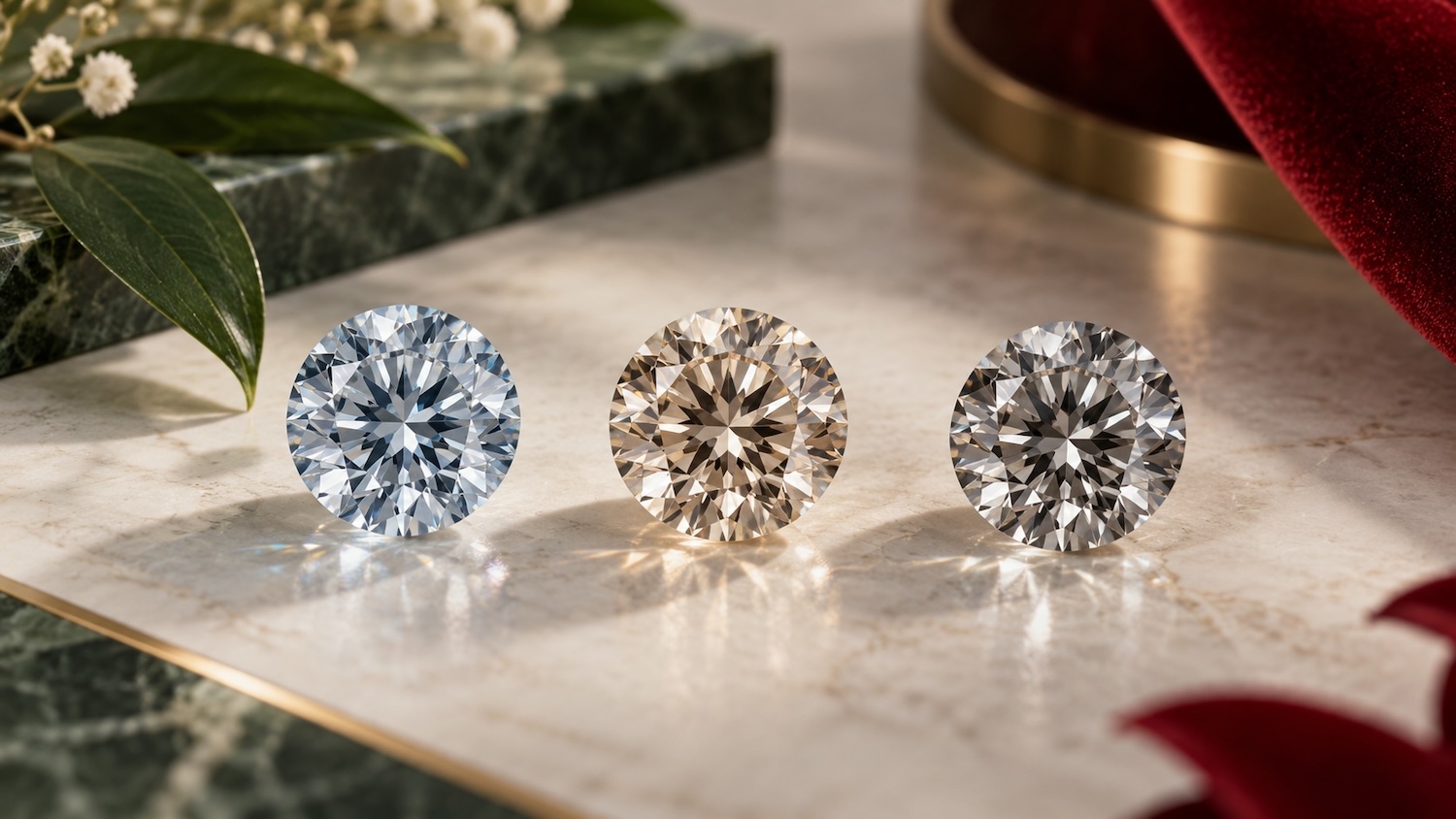
Lab-grown diamonds can receive excellent color and clarity grades while still displaying subtle visual characteristics that are not fully communicated by the basic specifications on a grading report.
Three of the most important are blue, brown, and gray nuance.
A nuance is a secondary body color or undertone that influences the overall appearance of the diamond. It may be obvious in photographs and videos, or so subtle that it is only noticeable when the diamond is compared directly with a more neutral stone.
These nuances are particularly important when buying lab-grown diamonds because different growth processes can introduce trace elements, structural defects, strain, or other characteristics that affect the way the finished diamond looks.
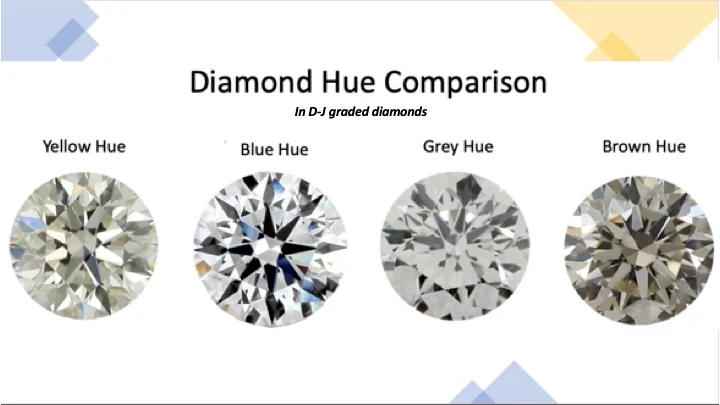
My general rule is simple:
If you are buying a colorless lab-grown diamond, I want it to look neutral, bright, and transparent. I would normally avoid obvious blue, brown, or gray nuance unless you genuinely prefer the appearance and understand what you are buying.
However, the three colors are not identical.
A very subtle blue nuance can sometimes create an attractive icy appearance. Brown usually introduces warmth that shoppers purchasing D to F color diamonds are specifically trying to avoid. Gray can create a steely or muted appearance and is one of the characteristics I inspect particularly carefully.
The key is to evaluate the actual diamond, rather than assuming an impressive color grade guarantees a completely neutral appearance.
If you are new to lab-grown diamonds, start with my guide to the 4Cs of diamonds and lab-grown diamond color guide.
Blue vs. Brown vs. Gray Nuance at a Glance
| Nuance | Typical Appearance | Common Association | My Approach |
|---|---|---|---|
| Blue | Cool, icy, blue-gray | Frequently associated with HPHT growth and trace boron | Mild examples can be attractive, avoid obvious unwanted blue |
| Brown | Warm, champagne, tea-colored | Often associated with growth defects in CVD material | Usually avoid in colorless-grade diamonds |
| Gray | Steely, smoky, metallic, dull | Can have several growth-related causes | Usually avoid if clearly visible |
| No obvious nuance | Neutral white appearance | Possible with both HPHT and CVD | Preferred for a conventional colorless diamond |
These are general patterns, not rules that allow you to judge a diamond solely from its growth method.
HPHT does not automatically mean blue. CVD does not automatically mean brown.
Both methods can produce excellent, visually neutral diamonds.
Both can also produce stones I would reject.
What Does “Nuance” Mean in a Lab-Grown Diamond?
When I refer to diamond nuance, I am talking about an underlying color character that goes beyond simply saying a diamond is D, E, F, G, or another conventional color grade.
Imagine two lab-grown diamonds that are both graded:
E color, VS1 clarity
On paper, they appear almost identical.
But when placed side by side:
- One looks bright and neutral
- One has a faint blue cast
- One looks slightly brown
- One appears gray or steely
That difference can matter more visually than the one-letter difference between two conventional color grades.
This is why I do not recommend shopping for lab diamonds using certificate specifications alone.
The grading report is extremely important, but a high-quality purchase should also involve:
- Actual diamond imagery
- Video
- Transparency assessment
- Growth quality
- Cut performance
- Body color
- Any visible nuance
My lab-grown diamond certification guide explains why the certificate should be treated as one part of the buying process rather than the complete evaluation.
What Is Blue Nuance in a Lab-Grown Diamond?
Blue nuance is a subtle blue, blue-gray, or occasionally greenish-blue character within the diamond.
It is most strongly associated with certain HPHT-grown diamonds.
HPHT stands for High Pressure High Temperature. You can read more about the process in my HPHT lab-grown diamond guide.
During HPHT growth, very small quantities of boron can become incorporated into the diamond crystal.
Boron can contribute to blue coloration.
This is particularly interesting because boron can also produce blue coloration in rare natural diamonds. However, a subtle blue undertone in a nominally colorless lab-grown diamond should not be confused with a deliberately purchased Fancy Blue diamond.
For somebody shopping for a D, E, F, or G lab-grown diamond, the objective is normally a neutral white appearance, rather than an obvious secondary blue color.
Is Blue Nuance Always Bad?
No.
Of the three nuances discussed here, blue is probably the one where personal preference matters most.
A very subtle blue character can sometimes make a diamond appear:
- Icy
- Crisp
- Cool
- Extremely white
Some buyers genuinely like that appearance.
The problem comes when the diamond begins to look:
- Clearly blue
- Blue-gray
- Steely
- Artificially cool
rather than naturally colorless.
If you are paying a premium for a D or E color diamond, I would generally prefer a stone that looks genuinely neutral.
But I would not reject an otherwise exceptional diamond because an extremely subtle cool character can be detected only during side-by-side comparison.
What matters is whether you can see it during normal viewing.
Blue Nuance Is Not the Same as Fluorescence
Blue nuance and blue fluorescence are different characteristics.
Blue nuance describes visible body coloration.
Fluorescence describes a diamond’s reaction to ultraviolet light.
A diamond can therefore have:
- Blue nuance without strong fluorescence
- Fluorescence without blue nuance
- Both
- Neither
This matters because shoppers sometimes see blue in a photograph and immediately assume the diamond must have fluorescence.
The blue could instead be:
- Body color
- Camera white balance
- Studio lighting
- Environmental reflection
- A genuine blue nuance
That is why one photograph is rarely enough to judge a diamond.
What Is Brown Nuance in a Lab-Grown Diamond?
Brown nuance gives the diamond a warmer appearance.
Depending on severity, it may look:
- Slightly warm
- Beige
- Champagne-colored
- Tea-colored
- Brownish
Brown coloration has historically been associated particularly with certain CVD-grown diamonds, where structural defects created during crystal growth can influence the diamond’s color.
Modern CVD production has improved considerably, and post-growth treatment can also improve the color of some diamonds.
That means you should not assume:
CVD = brown.
High-quality CVD diamonds can be beautifully neutral.
But if a nominally colorless lab-grown diamond visibly looks brown, I would usually choose another stone.
Why I Am More Cautious About Brown Nuance
For most buyers seeking a colorless engagement-ring diamond, brown nuance works directly against the desired appearance.
A faint warm tone is not automatically unattractive.
But if I am choosing between:
Diamond A: E color, visibly brownish
and:
Diamond B: F color, visually neutral
I would generally prefer Diamond B.
The F color grade may appear technically lower on the report, yet the actual diamond may look cleaner and more colorless.
This is an important lesson when buying lab-grown diamonds:
Do not allow the letter grade to overrule what the diamond actually looks like.
The difference between D, E, and F is already extremely subtle to the unaided eye.
An unwanted secondary color can matter much more.
What Is Gray Nuance in a Lab-Grown Diamond?
Gray nuance can be one of the more difficult lab-grown diamond characteristics to describe.
It may give the diamond a:
- Steely appearance
- Smoky appearance
- Metallic cast
- Slight darkness
- Muted appearance
Unlike blue nuance, which can occasionally create an attractive icy effect, noticeable gray can make a diamond look less lively even if its underlying cut is good.
The causes of gray coloration can vary depending on the diamond’s growth history, trace impurities, internal characteristics, and post-growth treatment.
For the consumer, however, the precise laboratory mechanism matters less than the visual result.
If the stone looks gray beside comparable neutral diamonds, I usually see little reason to accept it.
Does Gray Nuance Mean the Diamond Has Poor Transparency?
Not necessarily.
Color and transparency are related visually but should be evaluated separately.
A diamond can have a gray body color while still being transparent.
Another diamond may have little obvious gray coloration but suffer from reduced transparency due to strain, graining, or other growth characteristics.
Poor transparency can make a diamond look:
- Hazy
- Cloudy
- Sleepy
- Milky
- Less crisp
Gray nuance can instead make an otherwise clear diamond appear colder or darker.
Sometimes the two characteristics can occur together, making the diamond particularly unattractive.
This is one reason why I recommend looking beyond the grading report.
A certificate may contain excellent numbers while the actual diamond still looks underwhelming.
Where I Recommend Buying Quality-Focused Lab-Grown Diamonds
For buyers who want a more quality-focused approach, I recommend starting with Whiteflash. Its Precision Lab collection places particular emphasis on cut quality and careful diamond selection rather than simply offering the largest possible stone for the lowest price.
Blue Nile is useful if you want a much broader lab-grown diamond inventory and the ability to compare multiple stones with similar carat, color, and clarity specifications.
Brilliant Earth also offers a large lab-grown diamond selection and is worth comparing if you want plenty of engagement ring and customization options.
Whichever retailer you choose, I would evaluate actual body color, transparency, cut quality, and video, rather than buying from the certificate alone.
Which Is Worse: Blue, Brown, or Gray Nuance?
There is no objective ranking that applies to every diamond.
However, if I am shopping for a conventional colorless lab-grown diamond, my approach is generally:
Very Slight Blue Nuance
Potentially acceptable.
I would consider it if:
- The diamond looks neutral face-up
- The blue is extremely subtle
- Transparency is excellent
- Cut quality is excellent
- I personally like the cool appearance
Obvious Blue Nuance
Usually avoid.
If I can immediately see that a supposedly colorless diamond looks blue, I would normally select another stone.
Brown Nuance
I am generally more cautious.
Brown warmth tends to work against the neutral appearance most people are paying for when choosing higher color grades.
Gray Nuance
I am also cautious.
A clearly gray or steely appearance can make a diamond look duller or less appealing than a neutral comparison stone.
Ultimately, though:
I would take a beautiful diamond with an almost imperceptible blue nuance over a poorly cut neutral diamond.
Cut and overall visual performance still matter enormously.
Can D Color Lab Diamonds Have Nuance?
Yes.
This is one of the reasons buying by specifications alone can be misleading.
A high conventional color grade does not necessarily tell you everything about the diamond’s appearance.
A D-color lab-grown diamond can potentially display an unusual cool or gray character.
Likewise, an F-color stone can look beautifully neutral.
This does not make the laboratory color grade meaningless.
Color grading remains extremely useful.
But consumers should understand that a letter grade cannot communicate every visual characteristic created during laboratory growth.
My lab-grown diamond color guide explains why D is not automatically the smartest purchase simply because it sits at the top of the grading scale.
D vs. E vs. F: Nuance Can Matter More Than One Color Grade
Imagine three diamonds:
Diamond A
D color, VVS1 clarity, visible gray nuance.
Diamond B
E color, VS1 clarity, slight blue nuance detectable only in comparison.
Diamond C
F color, VS2 clarity, completely neutral, excellent transparency.
If all three are equally well cut, I would be strongly interested in Diamond C.
Why?
Because the actual appearance matters more than maximizing laboratory specifications.
You generally cannot distinguish D from F color with ease once a high-quality diamond is mounted and viewed normally.
A visible gray or brown undertone can be much more obvious.
This is also why lab-grown diamond buyers should not overspend unnecessarily on clarity.
An eye-clean VS diamond with excellent material quality can be far preferable to a VVS diamond with unattractive growth-related characteristics.
Do HPHT Diamonds Always Have Blue Nuance?
No.
This is an important misconception.
HPHT is a growth method, not a visual defect.
HPHT can produce excellent:
- D color
- E color
- F color
- Visually neutral
- Highly transparent
lab-grown diamonds.
Some HPHT diamonds may show blue nuance because of boron, but many do not show an objectionable tint at all.
The sensible question is not:
“Is this diamond HPHT?”
It is:
“Is this particular HPHT diamond attractive?”
That distinction is crucial.
Rejecting every HPHT diamond would mean unnecessarily excluding many excellent stones.
Do CVD Diamonds Always Have Brown Nuance?
No.
The same principle applies.
CVD stands for Chemical Vapor Deposition.
Older or lower-quality CVD material may sometimes display brown coloration or growth-related characteristics, but modern CVD technology can produce extremely attractive diamonds.
Some CVD diamonds also undergo post-growth treatment to improve color.
The correct question remains:
What does this diamond actually look like?
A great CVD diamond can be preferable to a mediocre HPHT diamond.
A great HPHT diamond can be preferable to a mediocre CVD diamond.
Do not choose the growth method before choosing the diamond.
What About Post-Growth Treatment?
Lab-grown diamonds can undergo post-growth treatment to improve their appearance.
This is not necessarily something to fear.
Treatment can be used to improve color characteristics that developed during growth.
For example, some CVD diamonds may undergo HPHT treatment after growth.
The important thing is transparency about what you are buying.
Your grading documentation should accurately identify the diamond as laboratory-grown and disclose relevant treatment information where applicable.
My guide comparing untreated vs. treated lab-grown diamonds explains why treatment should be understood rather than automatically treated as a reason to reject a stone.
The finished diamond’s quality still matters most.
Does Nuance Affect Diamond Durability?
Blue, brown, or gray nuance is primarily an appearance issue.
A color nuance does not automatically mean a lab-grown diamond is structurally weak.
Lab-grown diamond is still diamond.
The more relevant questions are:
- Does the diamond look attractive?
- Is transparency good?
- Are inclusions acceptable?
- Is the cut excellent?
- Are there other growth-related characteristics?
Do not confuse color nuance with durability concerns caused by particular inclusions.
They are separate issues.
Can Nuance Affect Sparkle?
Not directly in the way poor cut does.
Diamond sparkle is driven primarily by:
- Proportions
- Facet relationships
- Optical symmetry
- Light return
But nuance changes the overall character of the light you see.
A gray diamond with excellent cut may still produce strong reflections, but those reflections may have a steely appearance.
A brown diamond may produce plenty of brilliance while still looking warmer than you wanted.
A slightly blue diamond may sparkle beautifully but look cooler.
Transparency is another separate factor.
If a diamond also contains strain or growth characteristics that reduce transparency, then brilliance can appear less crisp.
My guide to lab-grown diamond strain and striations explains why this is another characteristic worth evaluating before buying.
What Does Blue Nuance Look Like in Videos?
Blue nuance can sometimes be identified in high-resolution rotating video.
Look for a blue tone that persists as the diamond rotates.
However, be careful.
Diamonds are extremely reflective.
They will pick up colors from:
- The camera
- The room
- Clothing
- Lighting
- Backgrounds
- Computer screens
One blue reflection does not mean the diamond has blue body color.
What I look for is a consistent cool cast throughout the diamond across several angles.
Comparison is extremely helpful.
If one diamond looks neutral while another repeatedly looks blue under identical photography, there is a stronger reason to investigate.
What Does Brown Nuance Look Like in Videos?
Brown nuance can appear as a persistent warm or tea-colored cast.
Again, one warm reflection is not enough.
Look at:
- The body of the diamond
- Areas away from strong white reflections
- Side views
- Pavilion views
- Several points in the rotation
Compare it directly with other diamonds from the same retailer photographed under the same conditions.
If several comparison diamonds look neutral and one consistently appears warmer, that is meaningful.
What Does Gray Nuance Look Like in Videos?
Gray can be particularly tricky because strong contrast is a normal component of diamond appearance.
Round brilliant diamonds need areas of light and dark to produce scintillation.
Dark arrows in a well-cut round are not “gray nuance.”
Instead, I look for a general gray or smoky character affecting the body of the stone, rather than individual dark facet reflections.
A gray diamond may appear less cleanly white even as the reflections move.
Side-by-side comparison is again the best approach.
Do Not Confuse Contrast With Gray Nuance
This deserves emphasis.
Beautifully cut diamonds are not uniformly white.
They show dynamic patterns of:
- Brightness
- Darkness
- Fire
- Contrast
Contrast gives a diamond life.
A Hearts and Arrows round, for example, can show clear dark arrows when photographed from certain positions.
That is not a defect.
Gray nuance is different.
It refers to the overall body character of the material rather than the normal light and dark facet pattern created by cut.
Do not reject a well-cut diamond simply because its video contains dark reflections.
Transparency Matters as Much as Nuance
When I assess lab-grown diamond material quality, I do not stop after asking whether it looks blue, brown, or gray.
I also want to know whether the stone is crisp and transparent.
A diamond with poor transparency can look hazy even if its body color is relatively neutral.
This can result from growth-related structural characteristics.
I would rather buy:
F VS2 + neutral appearance + excellent transparency + exceptional cut
than:
D VVS1 + hazy material + mediocre cut
even though the second diamond has more impressive headline specifications.
This is why the cheapest large lab-grown diamond is not necessarily the best value.
My guide to cheap lab-grown diamonds explains why headline carat and price should not replace quality assessment.
Cut Quality Still Comes First
Nuance matters.
But do not become so obsessed with nuance that you ignore cut.
For a conventional colorless lab-grown diamond, my priorities are broadly:
- Excellent cut and light performance
- Good transparency
- No distracting color nuance
- Eye-clean clarity
- Sensible color
- Appropriate carat weight
That ordering is intentionally different from simply buying:
D / VVS1 / biggest possible
A beautifully cut F VS2 can look much better than an average D VVS diamond.
The certificate describes the diamond.
It does not wear the diamond for you.
Does Diamond Shape Affect How Visible Nuance Is?
Yes.
Different shapes conceal or reveal body color differently.
Round Brilliant
The complex brilliant faceting can help disguise subtle color.
Strong brightness and scintillation can make slight nuances difficult to detect in normal viewing.
Radiant and Cushion
These brilliant-style cuts can also break reflections into smaller flashes, although appearance varies substantially between individual stones.
Oval and Pear
Elongated shapes can sometimes show more visible body color toward their tips or ends.
Emerald and Asscher
Step cuts deserve particularly careful inspection.
Their broad, open facets allow you to see more deeply into the diamond.
That makes:
- Nuance
- Inclusions
- Transparency issues
easier to notice.
I would therefore be particularly selective about material quality when buying a large emerald or Asscher-cut lab-grown diamond.
Does Carat Weight Affect Nuance?
Larger diamonds can make subtle material characteristics easier to see.
A tiny blue undertone in a 0.50 carat diamond may be extremely difficult to detect.
Spread that same type of coloration across a 4 carat stone and it can become more noticeable.
This matters because lab-grown diamonds make very large carat weights accessible to far more buyers.
My guide to large lab-grown diamonds explains why quality selection becomes even more important as diamond size increases.
Do not assume:
bigger = better.
A huge gray, brown, or hazy diamond can be far less attractive than a somewhat smaller stone with superior material quality.
Quality Matters More Than Chasing the Largest Lab Diamond
I particularly like Whiteflash Precision Lab diamonds for buyers who want to prioritize cut and overall diamond quality rather than simply finding the lowest price per carat.
For buyers who want much more inventory to compare, Blue Nile provides a broad range of lab-grown diamonds across different sizes, shapes, color grades, and clarity grades.
Brilliant Earth is another large retailer worth comparing, particularly if you also want a wide choice of engagement ring settings.
You can compare these and other sellers in my guide to the best lab-grown diamond retailers.
The best purchase is not necessarily the biggest stone you can afford. It is the diamond that combines strong cut, good transparency, attractive color, and the right size for your budget.
Does Ring Metal Hide Blue, Brown, or Gray Nuance?
The surrounding metal can influence how you perceive color, but it does not fundamentally change the diamond’s body color.
White Gold and Platinum
These metals create a cool surrounding environment.
A very subtle blue character may blend more naturally into white metal.
Gray nuance may also be slightly less obvious in some lighting, although I would not rely on the setting to hide an unattractive stone.
Yellow Gold
Yellow gold introduces warm reflections.
That can make subtle color distinctions harder to judge once the diamond is mounted.
Rose Gold
Rose gold introduces additional warm pink reflections.
Again, this can change the overall impression of the diamond.
My preference is to judge the diamond loose and against a neutral background before considering how the ring metal will affect its appearance.
If I dislike the diamond loose, I do not buy it in the hope that the setting will fix it.
Can a Slightly Blue Diamond Look Whiter?
Sometimes.
This is why blue nuance needs more nuanced treatment than brown or gray.
Human vision can interpret a subtle cool tone as extremely white.
Products ranging from paper to clothing have historically used slight blue optical effects to enhance the impression of whiteness.
A very mild blue character in a diamond can therefore create an icy impression.
However, there is a threshold.
Once you think:
“That diamond looks blue”
rather than:
“That diamond looks exceptionally white”
you are dealing with a different aesthetic.
There is nothing wrong with liking it.
I simply would not buy it unintentionally.
Should a Diamond With Nuance Cost Less?
Potentially.
If a visible secondary color makes the diamond less desirable within the conventional colorless market, price should be part of your evaluation.
But I would not buy an unattractive diamond simply because it is discounted.
Suppose you have:
Diamond A: $1,100, obvious gray nuance.
Diamond B: $1,250, visually neutral and otherwise comparable.
Saving $150 may look sensible on a spreadsheet.
But if Diamond B is the stone you prefer every time you look at your ring, it could represent much better value.
Lab-grown diamonds are already relatively affordable compared with equivalent natural diamonds.
There is rarely a strong reason to accept an obvious material-quality compromise for a modest additional saving.
Should You Avoid Every Lab Diamond With Nuance?
No.
This would be too simplistic.
There is a difference between:
laboratory-detectable characteristic
and:
visually distracting characteristic.
You are buying jewelry to look at with your eyes.
If an experienced observer needs specialized conditions and a direct comparison to identify an extremely subtle undertone, it may have virtually no practical significance.
If you can see the nuance immediately in normal viewing, it matters much more.
This is the standard I would use.
How to Compare Lab-Grown Diamonds for Nuance
If you are shopping online, compare several diamonds from the same retailer.
Keep the following similar:
- Shape
- Carat weight
- Color
- Clarity
- Video system
Then watch the stones side by side.
Look for:
Persistent Color
Does one diamond remain blue, brown, or gray as it rotates?
Transparency
Does one look hazier or less crisp?
Face-Up Appearance
What does the stone look like when viewed normally from above?
Side View
Body color can sometimes become easier to detect from an angle.
Comparison
Which stone looks most neutral when viewed beside the others?
That last step is particularly useful.
You may struggle to identify nuance in isolation but notice it immediately when the diamond is compared with a neutral reference.
My Lab-Grown Diamond Nuance Checklist
Before buying, I would work through the following questions.
Is the Diamond HPHT or CVD?
Useful context, but not an automatic quality judgment.
Does It Have a Persistent Blue Tint?
If yes, decide whether you actually like it.
Does It Look Brown or Warm?
Make sure you are not paying for a high color grade that visually looks warmer than expected.
Does It Look Gray or Steely?
Compare it against other diamonds under identical photography.
Is the Diamond Transparent?
Look for crisp reflections rather than haze.
Is the Cut Excellent?
Do not sacrifice the most important beauty factor while obsessing over minor nuance.
Is It Eye Clean?
There is little reason to pay for unnecessary VVS clarity if a lower clarity grade is visually clean.
Is the Certificate Appropriate?
Verify laboratory-grown origin, grading information, and relevant treatments.
Can the Retailer Inspect It?
For an important purchase, ask whether someone can physically examine the diamond and comment on material quality.
When I Would Buy a Diamond With Blue Nuance
I would consider it if:
- The blue is extremely subtle
- It creates an attractive icy appearance
- The stone still looks neutral face-up
- Transparency is excellent
- Cut quality is exceptional
- The price makes sense
- I genuinely prefer it
I would not buy it merely because somebody told me:
“Blue is rare.”
A subtle blue nuance in a nominally colorless lab-grown diamond is not the same proposition as a valuable natural Fancy Blue diamond.
When I Would Avoid Brown Nuance
I would normally avoid brown nuance when:
- It is visible face-up
- The stone looks noticeably warmer than comparable diamonds
- I am buying a D to F color diamond specifically for a white appearance
- Neutral alternatives are readily available
- The price saving is insignificant
There may be shoppers who like the warmer appearance.
That is completely legitimate.
But buy it intentionally.
When I Would Avoid Gray Nuance
I would usually avoid gray nuance when:
- The stone looks smoky
- It appears steely
- The color reduces the crisp appearance
- It is combined with weak transparency
- Other comparable diamonds look clearly more neutral
Gray can occasionally be subtle enough to have little practical effect.
Again, the visibility threshold matters.
Frequently Asked Questions
What causes blue nuance in lab-grown diamonds?
Blue coloration is particularly associated with some HPHT-grown diamonds where trace boron becomes incorporated into the diamond crystal.
Not every HPHT diamond is visibly blue.
What causes brown nuance in lab-grown diamonds?
Brown coloration can be associated with structural defects produced during growth, particularly in certain CVD-grown material.
Modern CVD diamonds can also be completely neutral.
What causes gray nuance in lab-grown diamonds?
Gray appearance can have multiple causes connected with growth conditions, impurities, defects, and the diamond’s overall material characteristics.
The important consumer question is whether the gray appearance is visually noticeable.
Which nuance is worst?
There is no universal answer.
For a conventional colorless diamond, I am generally cautious about visible brown and gray. Very subtle blue can occasionally look attractive, although obvious blue should still be purchased intentionally.
Is blue nuance bad?
Not automatically.
A tiny cool undertone may be attractive.
A strong blue-gray tint may be undesirable if you wanted a neutral white diamond.
Should I avoid brown lab diamonds?
If you are shopping for a conventional D to G colorless diamond and can clearly see brown coloration, I would normally choose another stone.
Should I avoid gray lab diamonds?
I usually avoid diamonds with an obvious gray or steely appearance when visually neutral alternatives are available.
Can a D color diamond have gray or blue nuance?
A high conventional color grade does not necessarily communicate every subtle appearance characteristic.
Actual imagery remains important.
Does HPHT mean blue?
No.
HPHT diamonds can be beautifully neutral.
Does CVD mean brown?
No.
Modern CVD production can create excellent colorless diamonds.
Does nuance affect diamond durability?
Not inherently.
Blue, brown, and gray nuance are principally appearance characteristics.
Does nuance affect diamond sparkle?
Color nuance does not directly determine brilliance, but it changes the overall appearance of the stone. Poor transparency can separately reduce visual crispness.
Can a setting hide nuance?
A setting can influence how color is perceived, but I would not buy an unattractive loose diamond expecting the metal to solve the problem.
Final Verdict: Blue vs. Brown vs. Gray Nuance
Blue, brown, and gray nuance are useful examples of why lab-grown diamonds should never be purchased solely from the numbers on a grading report.
A D-color diamond can have impressive specifications while still displaying a secondary appearance you dislike.
Meanwhile, an F VS2 lab-grown diamond can look beautifully white, transparent, and lively.
For a conventional colorless diamond, my preference is straightforward:
neutral body color + excellent transparency + exceptional cut.
A tiny blue nuance can occasionally create an attractive icy appearance, and I would not automatically reject it.
I am generally less enthusiastic about obvious brown or gray because these nuances can make the diamond look warmer, smokier, or less crisp than a neutral comparison stone.
But visibility is what matters.
Do not reject a diamond because someone tells you a microscopic growth characteristic exists.
Reject it when that characteristic makes the actual diamond less attractive.
Use my lab-grown diamond color guide to understand conventional color grades, my lab-grown diamond certification guide to understand the report, and my guide to strain and striations in lab-grown diamonds to assess another important area of material quality.
When comparing retailers, I recommend looking at Whiteflash if quality selection and cut performance are priorities, Blue Nile if you want a broad inventory to compare, and Brilliant Earth if you want another large range of lab-grown diamonds and settings.
The simplest rule is:
Do not buy the best certificate. Buy the best-looking diamond.